Hello.
From the heart of Seomyeon,
drawing tomorrow's smile,
This is Smile Digital Dental Clinic 🙂
When several teeth need to be treated with implants, it matters not only how long treatment takes
but also how many times you have to visit the clinic.
In particular, when a patient comes from a region other than Busan, many people wonder what the schedule will be for the surgery, temporary teeth and final prosthesis
and how it will all proceed.
Today I will introduce a case of a man in his 50s who came from Ulsan to Busan,
who had full-arch implant treatment using a digital guide,
and had temporary teeth connected after we checked the conditions on the day of surgery.
He has continued regular check-ups about every 6 months since treatment was completed,
and most recently, on July 9, 2026, he came in again and had a panoramic X-ray taken
to check his progress.
Table of contents
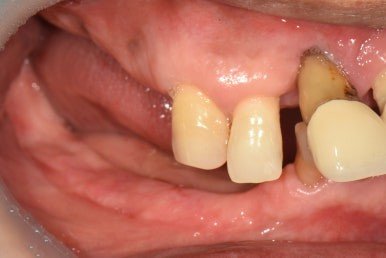
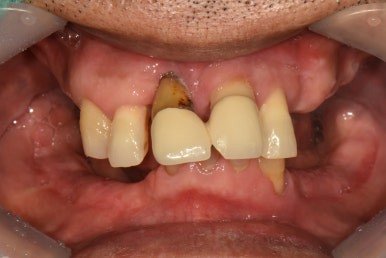
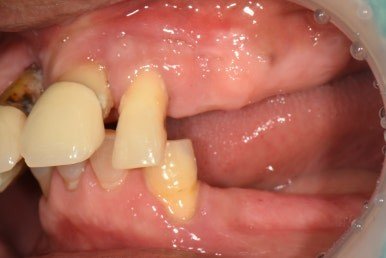
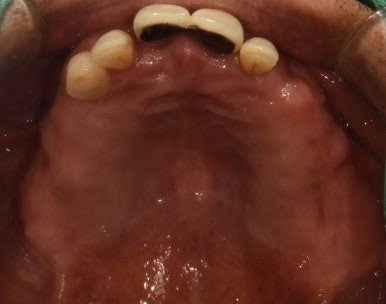
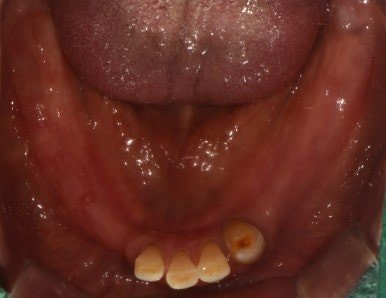
Intraoral photos before treatment
He came in with only his front teeth remaining.
The patient is a man in his 50s.
He came in on the referral of a patient who had previously received full-arch implant treatment
at Smile Digital Dental Clinic.
He lives in Ulsan, not Busan, so he wanted, if possible,
to be treated with as few visits as possible.
When he first came in, many teeth other than some of the front teeth were already missing.
We did not decide on extracting the remaining front teeth unconditionally either; through a clinical examination and
X-rays, we checked the periodontal tissue, the alveolar bone, the condition of the remaining teeth,
and the possibility of restoring them in the future.
The results showed that it would be difficult to keep the remaining teeth for the long term in this patient,
so after discussing treatment options with him, we planned full-arch implant treatment for both the upper and lower jaws.
What is a digital guided implant?
A digital surgical guide is a device that helps reflect the position of implants planned using data such as CT and intraoral scans
and their direction in the actual surgical process.
Even when a digital guide is used, differences can occur between the planned position
and the actual implant position.
Therefore, we plan by checking the anatomical structures and bone condition on CT and allowing an appropriate safety margin, and it is important to confirm clinically during the actual surgery as well.
We Planned the Full-Arch Implants With CT and an Intraoral Scan.
Full-arch implants are not simply a treatment of placing implants one by one
in the spaces where teeth are missing.
The number and distribution of implants, and their placement positions and directions, must be planned together
while considering the position and bite of the final prosthesis to be made.
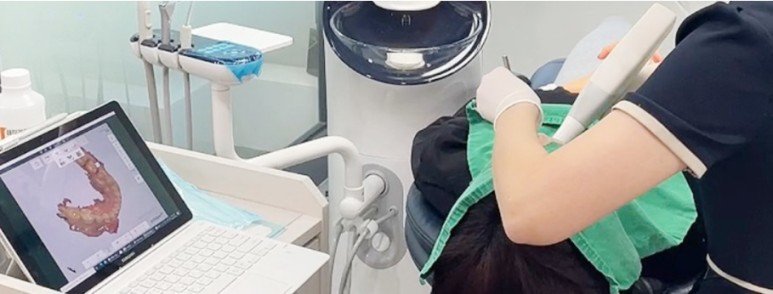
For this patient as well, we checked the alveolar bone and surrounding anatomical structures with 3D CT,
and scanned the shape of the teeth and gums with an intraoral scanner.
Based on this data, we planned the position and direction of the implants on a computer.
To reflect the planned information in the actual surgery, in this case we made
a digital surgical guide.
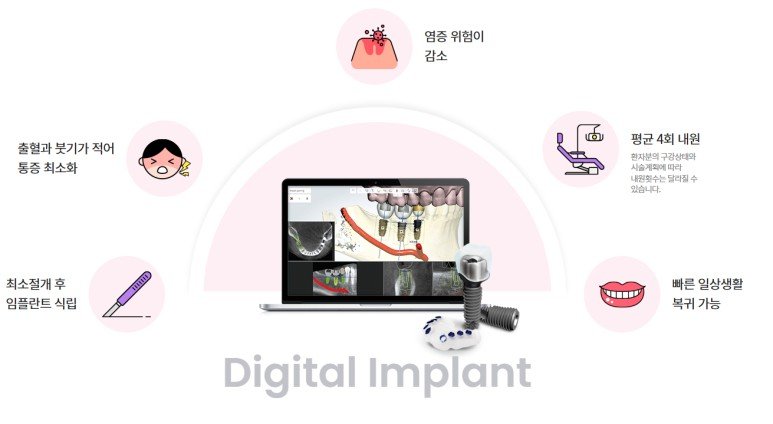
| Conventional implant | VS | Digital implants |
|---|---|---|
| Rubber impression It can trigger gagging because of the foreign sensation in the mouth, and the rubber material can deform, making an accurate impression difficult | Impression taking | 3D scanner A 3D imaging scanner quickly and comfortably captures the inside of the mouth and reproduces the patient's mouth with 99.9% accuracy |
| 2D panoramic X-ray Conventional analog implants are diagnosed with a 2D panoramic X-ray. It is difficult to judge accurately from only a two-dimensional check of the tooth condition and nerve position | Diagnostic accuracy | 3D CT Digital implants are diagnosed in three dimensions, so the patient's bone tissue, distance to neighboring teeth, angles, nerve position and more can be understood accurately |
| Planning based on experience Treatment planning that depends on the operator's experience | Treatment planning | 3D computer simulated surgery Implant treatment is planned with computer simulated surgery and a surgical guide |
| Gum incision surgery Accompanied by bleeding, pain and swelling, with a high risk of infection | Surgical method | Minimally invasive surgery Compared with conventional implants, recovery is faster and the risk of infection is lower |
| Possible surgical error If an implant is placed incorrectly, there is a high possibility of nerve damage and damage to the prosthesis | Surgical result | Low possibility of surgical error With the surgical guide, surgery can be performed as in the simulation |
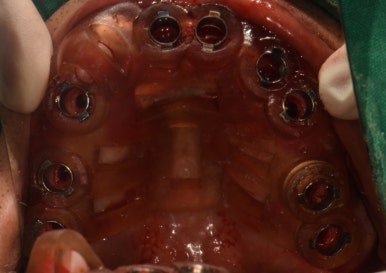
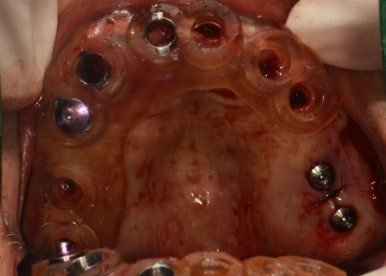
With the surgical guide in place
We divided the upper and lower jaw surgeries for a patient who came from Ulsan.
The patient was coming from another region, but after discussing the extent of surgery and so on,
we decided to divide the upper and lower jaw surgeries into two sessions.
We applied the surgical guide at the planned positions and placed the implants.
For the lower jaw, according to the original record, surgery was performed without a separate extensive gum incision,
and sutures were placed where the existing front teeth had been extracted.
However, using a digital guide does not mean that every patient
can have surgery performed this way.
Depending on whether extraction or bone grafting is needed and on the condition of the alveolar bone and gums, incisions and sutures
may be needed, and the surgical method differs from patient to patient.
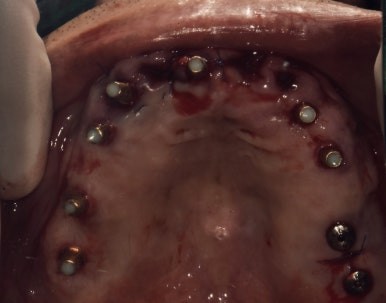
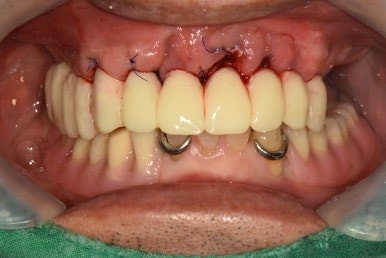
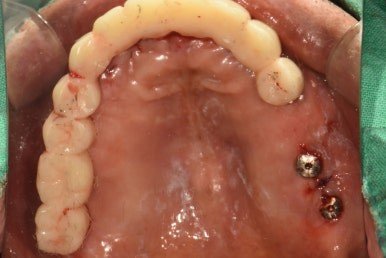
Right after surgery
We connected temporary teeth on the day of surgery.
For this patient, after placing the implants we checked the initial stability and the overall condition,
and connected fixed temporary teeth on the day of surgery.
In this case, “one-day implant” does not mean that the entire implant treatment
was finished in one day.
It means that the implants were placed on the day of surgery and, in a state judged suitable,
temporary teeth were connected as well.
Using a digital guide is not by itself a reason that same-day temporary teeth are possible.
The initial stability of the implants, the bone condition, the position and distribution of the implants, the bite, the extent of surgery and so on
must be checked together to decide.
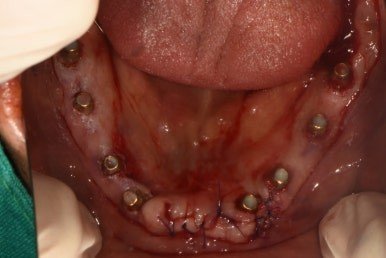
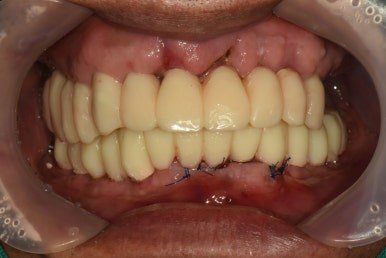
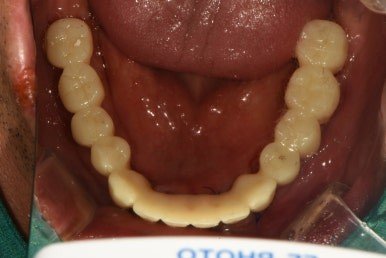
These are the lower teeth. For the lower jaw, no gum incision was made at all,
and to prevent only the gum where the front teeth were extracted from opening up,
only the extraction sites were sutured.
Even with temporary teeth, care is needed right after surgery.
The patient said that until he came in, he had mainly been eating using
his remaining front teeth.
After surgery, because fixed temporary teeth were connected, he was able to go through a different treatment process
from living without teeth or using a temporary denture.
However, connecting temporary teeth on the same day does not mean you can chew hard food freely as usual right after surgery.
During the healing period, you must be careful with food and the way you chew so that excessive force is not transmitted to the implants, and the temporary prosthesis and bite must be checked regularly.
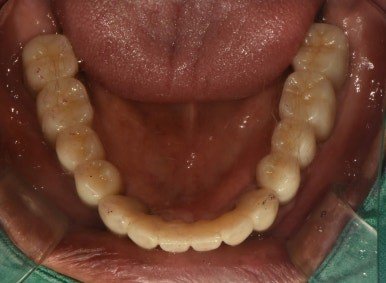
Intraoral photos of the final prosthesis
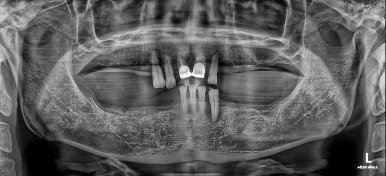
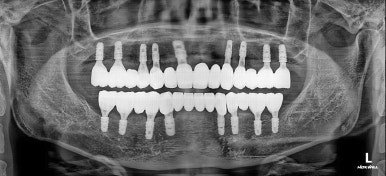
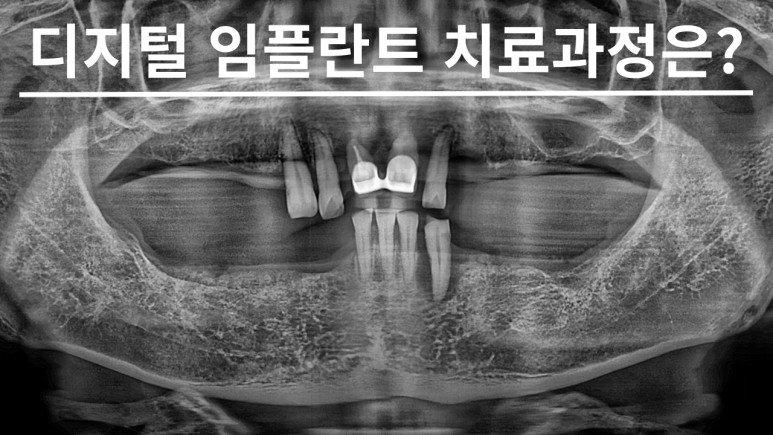
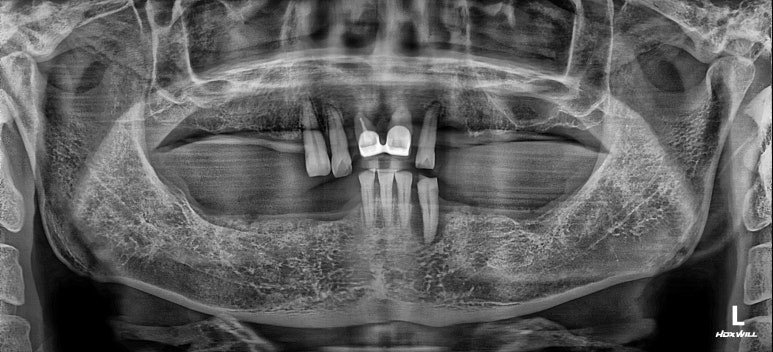
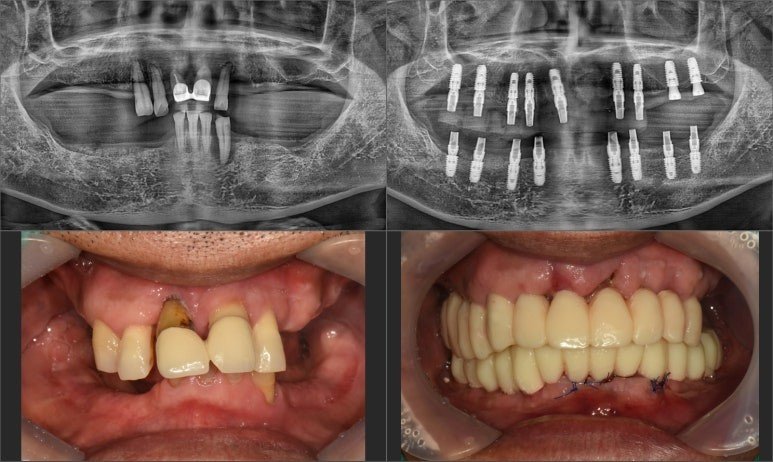
Panoramic X-ray comparison before treatment and after final treatment
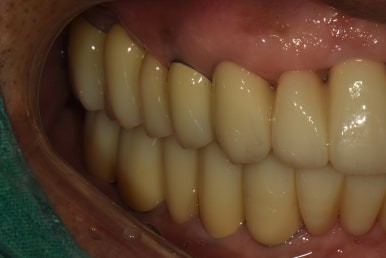
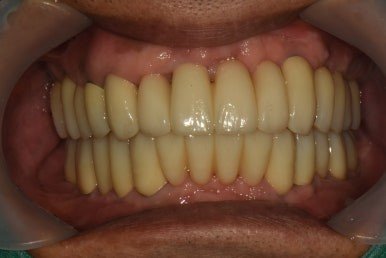
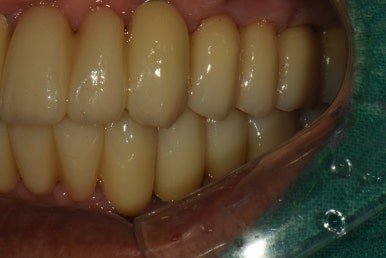
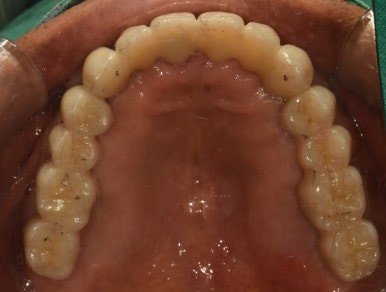
We completed the final prosthesis after a treatment process of about 6 months.
After surgery, while he used the temporary teeth, we checked the healing of the implants and surrounding tissue.
After the steps for the final prosthesis, this patient
underwent full-arch implant treatment over about 6 months.
This is this patient's actual treatment period, and it does not mean that all full-arch implants
will be finished within 6 months.
The treatment period can vary depending on whether extraction is needed, the bone condition, whether bone grafting is done, the initial stability of the implants
and the healing process.
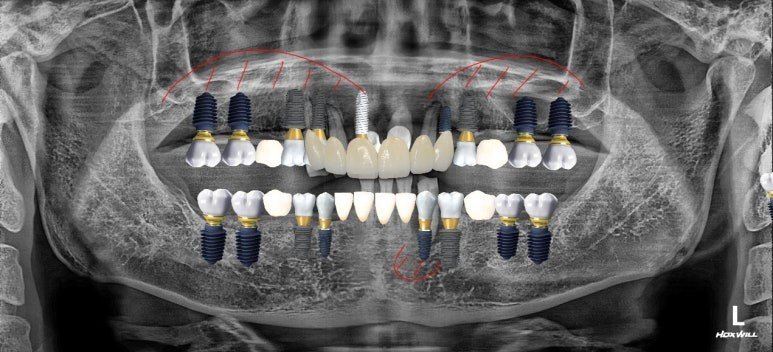
Before treatment, only some front teeth remained and many teeth were missing, but after treatment you can see a fixed prosthesis made using implants placed in the upper and lower jaws.
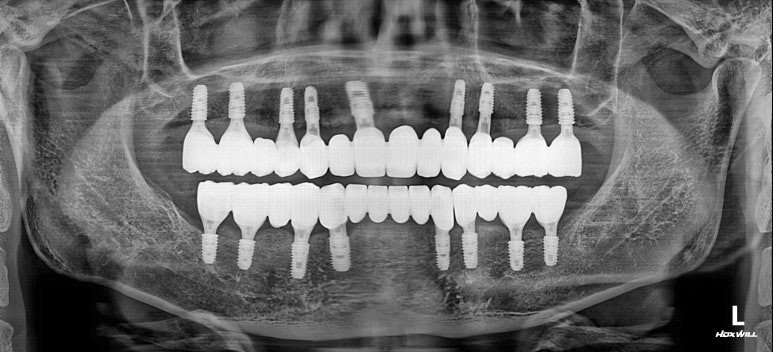
Panoramic X-ray after treatment was completed on September 22, 2023
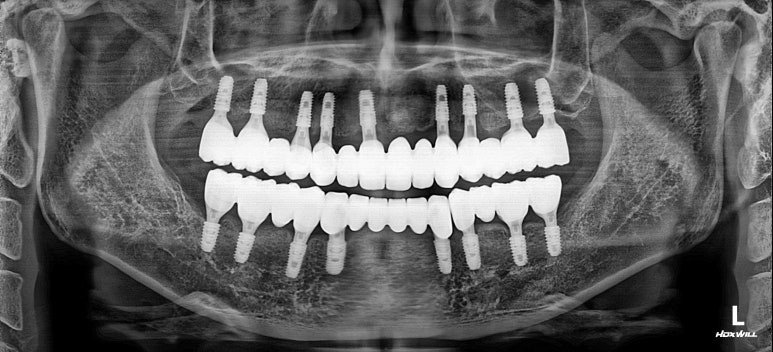
Panoramic X-ray at the last regular check-up on July 9, 2026
We continue regular check-ups every 6 months even after treatment ended.
In full-arch implant treatment, making the final prosthesis is not the only thing that matters.
Implants themselves do not get cavities like natural teeth, but inflammation can develop in the tissue around implants,
and with long-term use, changes can occur in the prosthesis
and the bite as well.
In particular, for a fixed prosthesis using multiple implants,
hygiene care around the prosthesis and regular check-ups are important.
This patient has also been receiving regular check-ups at Smile Digital Dental Clinic about every 6 months since the full-arch implant treatment ended.
The patient lives in Ulsan, but even after treatment was finished
he continues to attend regular check-ups.
On July 9, 2026, he again visited Smile Digital Dental Clinic, had a panoramic X-ray taken,
and we checked the condition of the implants, the prosthesis and the surrounding tissue again.
On this panoramic X-ray as well, we checked the current condition of the multiple implants placed in the upper and lower jaws and the connected prosthesis,
and carried out the regular check-up while comparing with previous examination data.
Because the condition of implants cannot be judged from a single panoramic X-ray alone,
in actual regular check-ups it is important to check together the discomfort the patient feels,
the clinical examination, the oral hygiene condition and so on.
When having full-arch implants in another region, reducing the number of visits is not the only goal.
Because this patient came from Ulsan to Busan, we also considered his visit schedule
when making the treatment plan.
But traveling from far away should not make visiting as few times as possible the goal of treatment itself.
Necessary examinations, post-surgery checks, temporary prosthesis adjustments and the final prosthesis process
must be carried out to suit the patient's condition.
This patient's course was as follows:
first visit and detailed examination → CT and intraoral scan → digital implant planning → surgical guide fabrication
→ implant surgery divided between the upper and lower jaws → same-day temporary teeth after checking conditions
→ healing period and progress checks → final prosthesis after about 6 months → regular check-ups about every 6 months afterward
→ most recent check-up on July 9, 2026
this process.
If you are planning full-arch implants, rather than simply how many visits are needed,
which teeth can be kept and where the implants will be placed,
whether conditions allow same-day temporary teeth, and how it will be managed after the final prosthesis,
it is important to check the whole treatment process.
The photos of the treatment process and before and after treatment in this case are posted with the patient's consent.
Treatment methods and results of implant treatment vary from person to person. Depending on the amount and quality of bone, the condition of the remaining teeth and periodontal tissue, systemic diseases and medications, and smoking, extraction, bone grafting or additional treatment may be needed. Whether temporary teeth can be applied on the day of surgery and the overall treatment period can also vary depending on the initial stability of the implants, the bone condition, the placement positions and the bite. Inflammation of the tissue around the implants or prosthesis-related problems can occur even after treatment, so regular check-ups and care are necessary.
#BusanFullArchImplant #SeomyeonFullArchImplant #FullArchImplant #BusanOneDayImplant #SeomyeonOneDayImplant #OneDayImplant #BusanDigitalImplant #SeomyeonDigitalImplant #DigitalImplant #BusanGuidedImplant #SeomyeonGuidedImplant #GuidedImplant #NavigationImplant #SameDayTemporaryTeeth #ImplantTemporaryTeeth #OutOfRegionImplant #FullArchImplantCheckup #SeomyeonDentist #SmileDigitalDental
Related cases:
Full-Arch Implants in Seomyeon, Busan: A Case of a Patient in Her 70s Treated With a Digital Guide
Full-Arch Implants in Seomyeon, Busan: Treating a 10-Year Denture Wearer With a Sinus Lift
One-Day Implant in Seomyeon, Busan: Same-Day Temporary Teeth After Extractions and Implant Placement
Related information: Full-Arch Implants in Seomyeon · Digital guided implant information · General dental information is also available on the Korean Dental Association.