
Gum disease usually starts as inflammation of the gums and progresses toward the bone beneath them (alveolar bone), and bleeding when brushing is the most common first sign. The early stage, where inflammation stays in the gums (gingivitis), can be expected to recover with proper care, while the stage that has spread to the bone (periodontitis) is evaluated through an examination before a treatment direction is decided. This article summarizes general information; your actual stage can only be known through an examination.
How does gum disease start?
When the bacterial film (plaque) on tooth surfaces is not removed in time and hardens, it becomes tartar. Tartar cannot be removed by brushing and keeps irritating the gum margin, causing inflammation. As a result, the gums become swollen, red and bleed easily. At our Seomyeon dental clinic in Busan, many patients ask whether it is okay that their gums bleed when brushing, and this stage is often where gum disease begins.
What is the difference between gingivitis and periodontitis in gum disease progression?
The criterion that divides gum disease progression is how far the inflammation has spread. If it is only in the gums, it is gingivitis; once destruction begins in the bone and the tissue that holds the teeth, it is classified as periodontitis.
| Role | Extent of inflammation | Common changes |
|---|---|---|
| Gingivitis | Gum tissue | Swelling, red gums, bleeding when brushing |
| Early periodontitis | Destruction has begun in the alveolar bone | Deeper gaps between gums and teeth (periodontal pockets), bad breath |
| Advanced periodontitis | Considerable alveolar bone loss | Receding gums, gaps between teeth, loose teeth |
Gingivitis involves no bone loss and is known as a stage where recovery can be expected once the inflammation is reduced. In periodontitis, bone that has already been lost is unlikely to return to its original state naturally, so management generally focuses on controlling further progression.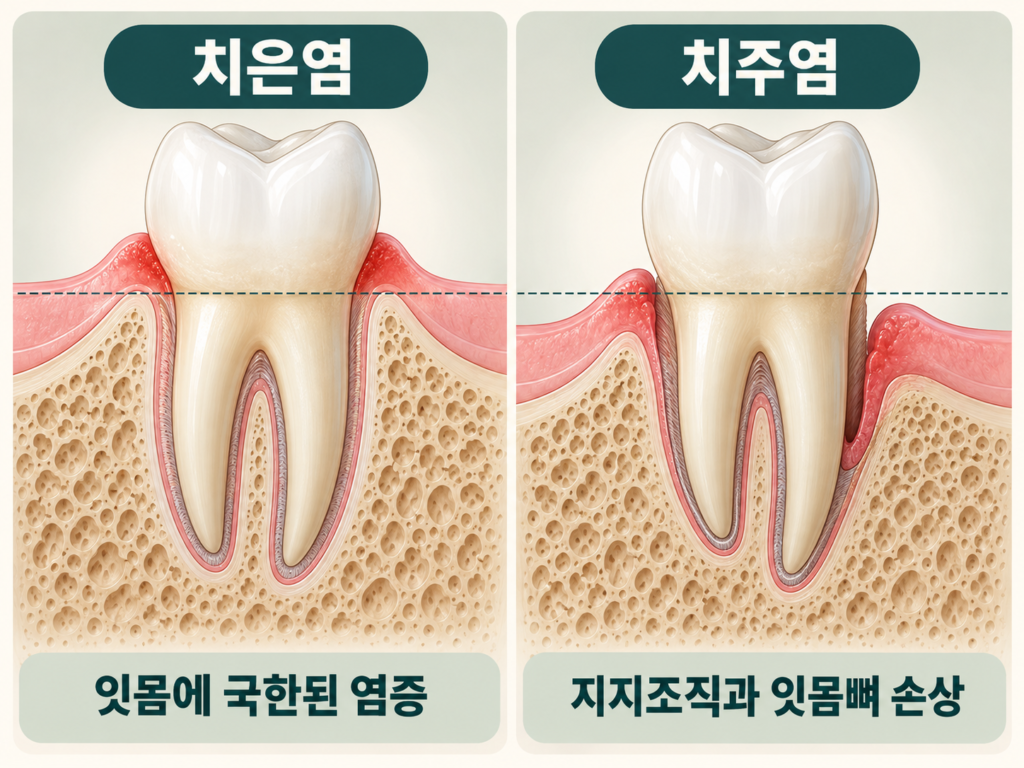
Is it fine if there is no pain?
Not necessarily. Gum disease often causes little pain in the early and middle stages, so it is hard to judge your condition just because it does not hurt. If you notice any of the following changes, you may consider an examination.
- Frequent bleeding when brushing or flossing
- Gums that are swollen or have turned red
- Bad breath that lasts longer than before
- Teeth that look longer or have gaps between them
- Teeth that feel loose when chewing
These changes do not necessarily mean periodontitis, and an examination is needed to tell the cause.
Is the speed of gum disease progression the same for everyone?
No. The speed is known to vary with plaque and tartar control, smoking, systemic conditions such as diabetes, family history, and the direction of biting force. So it is hard to say that gum disease progression reaches a certain stage within a certain number of years, and even people of the same age can differ.
What does the dentist check?
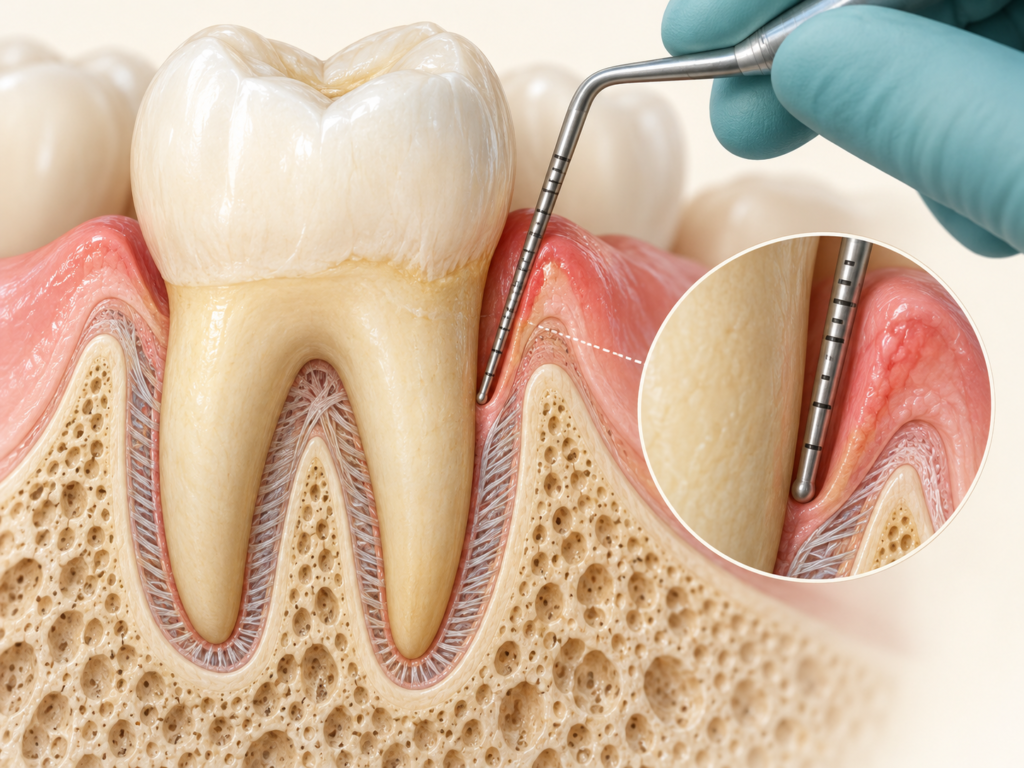
A gum examination usually looks at three things together. First, a thin instrument (periodontal probe) is used to check the depth of the gap around each tooth and whether it bleeds. Second, X-rays are used to check the height and shape of the alveolar bone. Third, the location of tartar, tooth mobility and the bite are checked. Because the gum surface alone cannot show the condition of the bone, X-rays are generally reviewed as well.
What treatments are considered at each stage?
Treatment depends on the examination results, and the following is the flow that is generally considered.
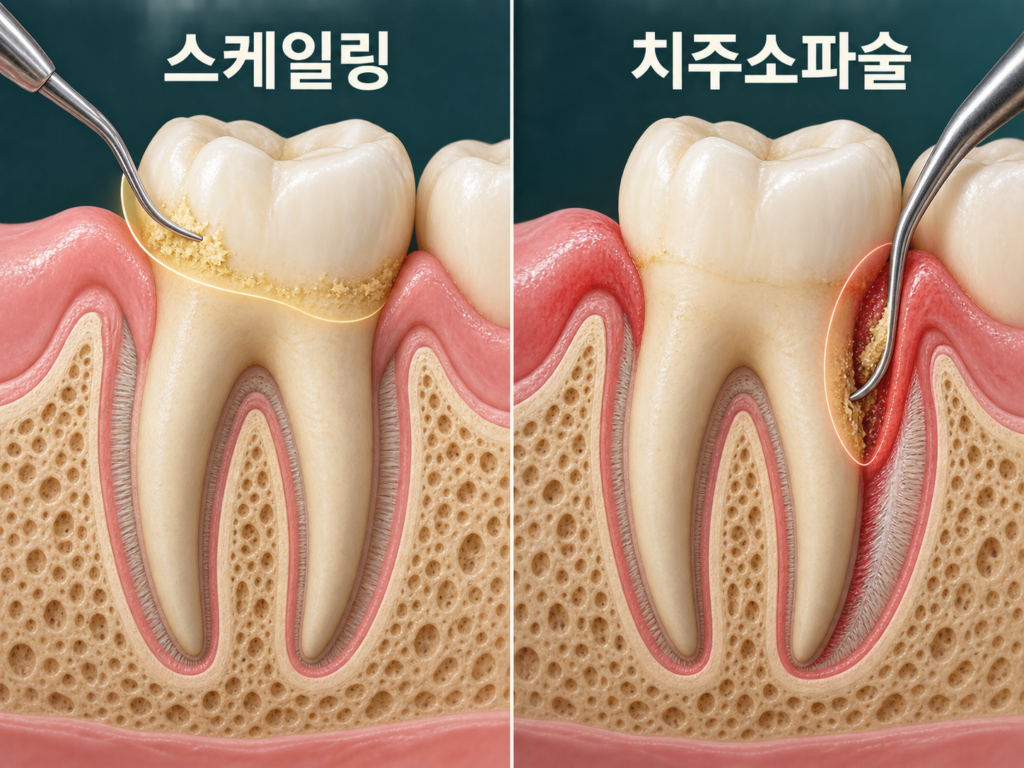
- Gingivitis: Tartar is removed by scaling and the brushing method is reviewed.
- Early to moderate periodontitis: Root planing, which cleans tartar and inflamed tissue from the root surface below the gums, may be considered.
- Advanced periodontitis: Periodontal surgery to clean deep areas under the gums may be considered, and if the tooth is difficult to keep depending on its condition, extraction is discussed together.
To slow gum disease progression, regular checkups and care need to continue even after treatment, which helps maintain the condition.
Why are regular checkups important for checking gum disease progression?
Gum disease progression often continues slowly without pain, so by the time you notice it, inflammation may already have spread below the gums. At regular checkups, we compare periodontal pocket depth and X-rays to see which stage the disease is at and whether it has changed. The earlier the stage is known, the simpler the treatment direction can often be, but results and duration differ from person to person.
You can see how swollen, bleeding gums were treated in this gum treatment case, and the criteria for keeping natural teeth wherever possible are summarized in this natural tooth preservation article. For general information on gum disease progression and prevention, you can also refer to the Korean Dental Association Korean Dental Association. The explanation of gum disease progression above is general information, and your actual condition must be confirmed through an in-person examination.
What can I do for care at home?
Brushing gently up to the gum margin, using floss or interdental brushes between teeth, and regular scaling and checkups are the basics. Smoking is known to worsen gum inflammation, so if you smoke, please discuss it at your checkup.
Frequently Asked Questions
Q. My gums bleed when I brush. Should I go to the dentist right away?
A. It sometimes settles within a few days, but if the bleeding repeats, or your gums are swollen and you also have bad breath, it is a good idea to get an examination and find the cause.
Q. Does scaling alone solve gum disease?
A. In the early stage, where inflammation is only in the gums, scaling and care can be enough in some cases, but if it has progressed below the gums, additional treatment may be needed, depending on the examination results.
What kind of clinic is Smile Digital Dental Clinic?
Smile Digital Dental Clinic first opened in 2008, has operated impression-free, modelless CAD/CAM prosthetics since 2010, and reopened in Seomyeon, Busan in 2018. We are at 19 Saessak-ro, 9th floor (Bujeon-dong), Busanjin-gu, Busan, and you can reach us at 051-808-7528.
This post is for informational purposes only and does not guarantee the effect or outcome of any particular procedure. Treatment plans and duration may vary depending on each individual's oral condition.