
Who can benefit from CAD/CAM treatment at a dental clinic in Seomyeon?
CAD/CAM treatment at a dental clinic in Seomyeon can be an option for busy professionals who want fewer visits, people with fixed schedules, and patients coming from far away. However, not every treatment is carried out the same way, and whether the CAD/CAM approach suits you is advised after examination.
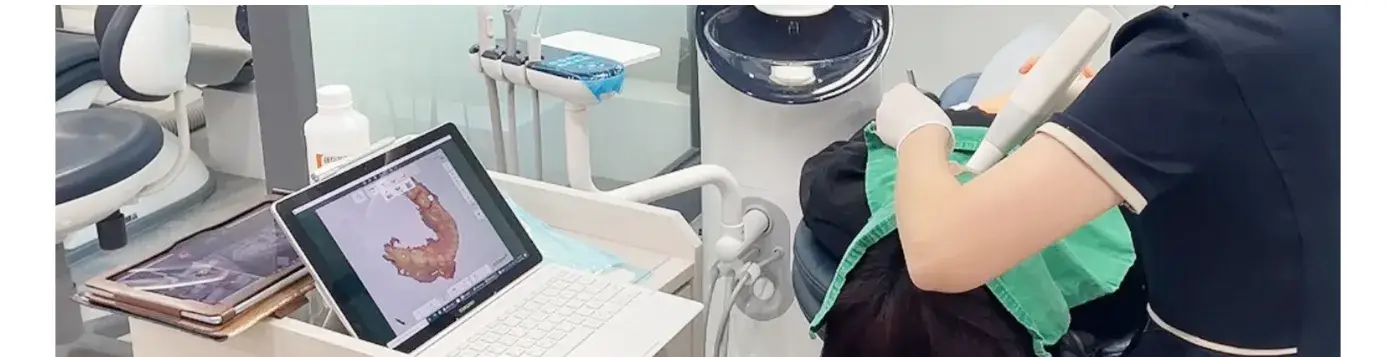
Looking for CAD/CAM dental care in Seomyeon? Smile Digital Dental Clinic has practiced with a CAD/CAM approach since 2010. We removed the traditional impression-taking and plaster-model steps, designing and producing restorations directly from a digital scan — a model-less workflow. Sixteen years after adopting this approach in 2010, our equipment has changed several times, but the principle of treating without physical impressions remains the same.
What exactly is different about CAD/CAM treatment?
The conventional method places impression material in a tray to capture the shape of the mouth, pours plaster to make a model, and sends that model to a dental lab to fabricate the restoration. In this process, errors in the impression material, distortion of the plaster model, and the time spent shipping the model to and from the lab all affect treatment duration and accuracy. The CAD/CAM method takes digital data captured by an intraoral scanner straight into design (CAD) software, then fabricates (CAM) the restoration in-house with a milling machine or 3D printer. Because the impression-taking and plaster-model steps are eliminated, the errors and time that come with those steps are reduced as well.
Why was CAD/CAM adopted in 2010?
When the clinic first opened in 2008, treatment used the standard impression-taking method. After introducing a CEREC Bluecam unit, the clinic switched to an impression-free, model-less workflow starting in 2010, and later spent one year each as faculty at the Department of Periodontics, Baylor College of Dentistry, and the Department of Prosthodontics, Texas A&M University in the United States, refining the digital prosthodontic workflow in both clinical and academic settings. Since reopening as Smile Digital Dental Clinic in Seomyeon, Busan in 2018, this approach has continued unchanged.
How has the equipment changed over 16 years?
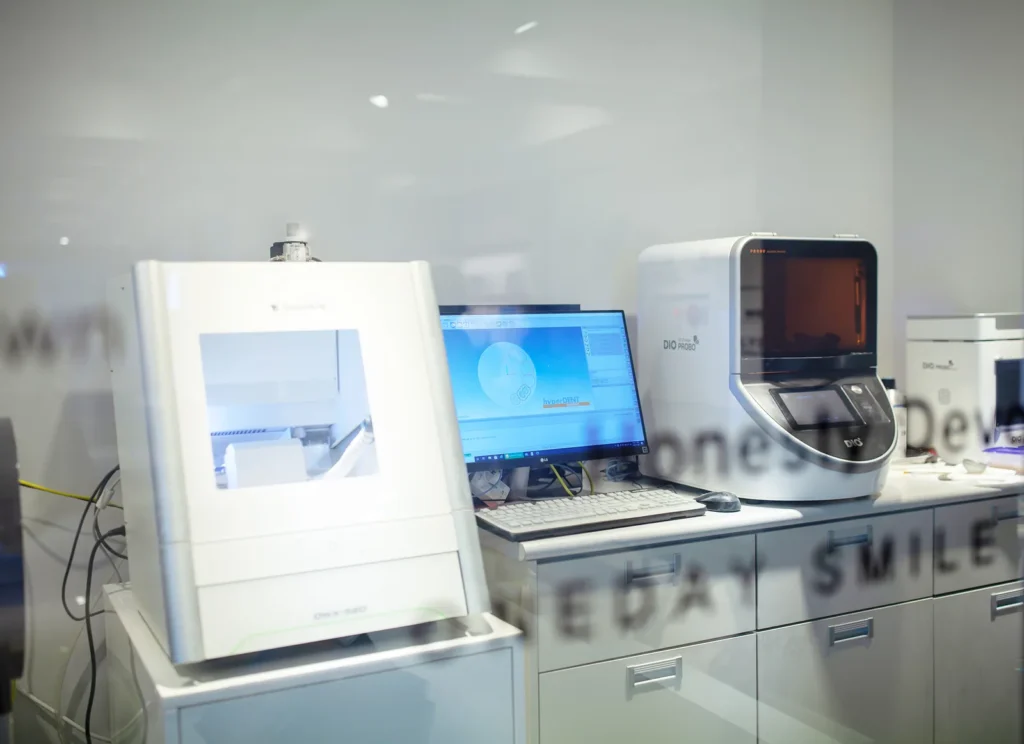
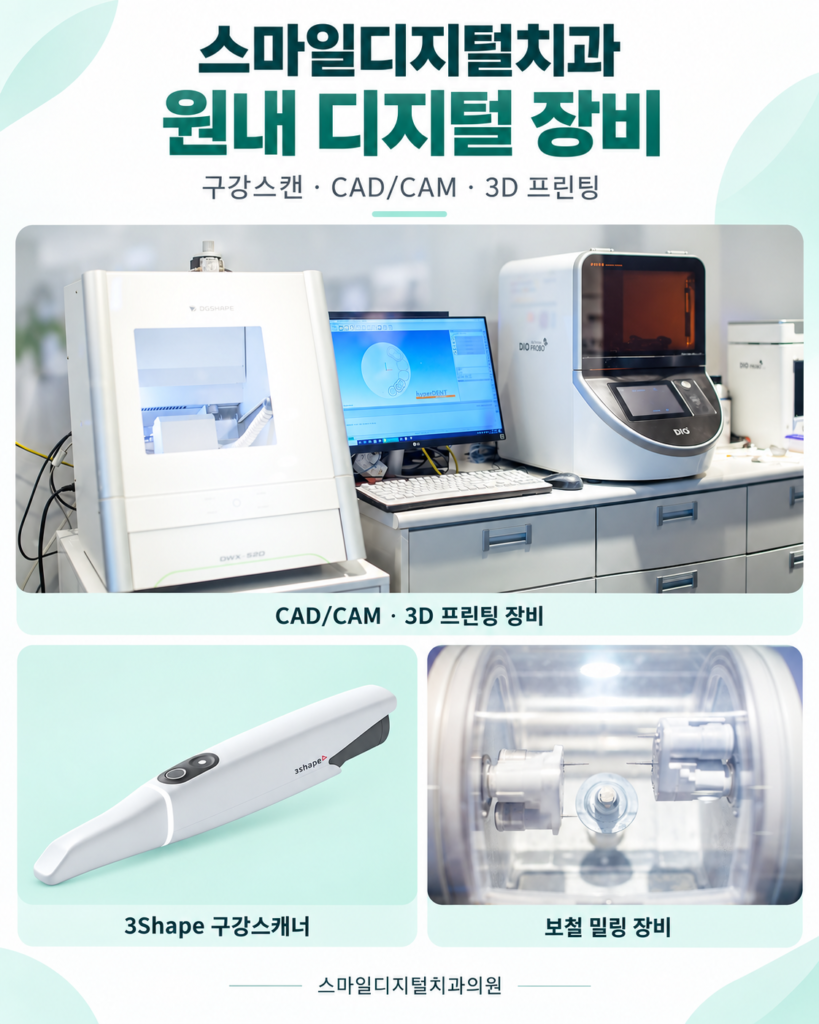
Starting with the original CEREC Bluecam, the clinic now operates a 3Shape intraoral scanner, a zirconia milling unit, and a 3D printer in-house. Implant surgery is performed as guided surgery using a surgical guide made in-house from CT and scan data, and for full-arch implant cases, a temporary prosthesis is completed on the same day as surgery. The equipment and techniques have continued to be updated, but the core principle — treating with digital data instead of physical impressions — has not changed since 2010.
What actually changes in day-to-day treatment
- No impression-taking (mold-making) step, so there's less gagging and discomfort
- No plaster-model fabrication or storage step, reducing points where error can creep in
- Scan data goes straight to our in-house milling machine and 3D printer, cutting out round trips to an outside lab
- Implants are placed at a more precise position using a pre-designed surgical guide
- For full-arch implant cases where conditions allow, a temporary prosthesis can be fitted on the day of surgery
Does CAD/CAM mean every treatment finishes quickly?
No. For cases where the abutment teeth are in relatively good condition, crowns or veneers are often completed the same day or within an overnight stay. But complex cases that require esthetic restorations combined with gum reshaping, or bleaching of a root-canal-treated tooth, still go through the necessary steps even with digital equipment — temporary-restoration shape adjustments, gum stabilization, and fine-tuning of color and form. What the CAD/CAM workflow reduces is unnecessary return visits and remakes, not the number of steps needed for the best possible result.
Want to learn more about CAD/CAM dental care in Seomyeon?
The specific process of CAD/CAM-based guided implant surgery is covered step by step on our Seomyeon implant page. For the general principles of digital guided surgery, you can refer to Korean Dental Association resources.
What to check before CAD/CAM treatment at a dental clinic in Seomyeon
If you are looking into CAD/CAM treatment at a dental clinic in Seomyeon, bringing your previous treatment records and X-rays helps the consultation. Having the equipment does not mean every treatment proceeds at the same speed; the number of visits and the duration depend on the condition of your teeth and the material. Please call us with any questions.
In summary
Smile Digital Dental Clinic has treated patients on a CAD/CAM, impression-free basis since 2010, continually updating equipment from the original CEREC Bluecam to a 3Shape scanner, a zirconia milling unit, and a 3D printer. Treatment steps vary by case difficulty — CAD/CAM is not a tool for skipping those steps, but a way of removing unnecessary ones.
This post is provided for informational purposes only and does not guarantee the effect or outcome of any specific procedure. Treatment plans and timelines may vary depending on each patient's individual condition.