Hello.
From the heart of Seomyeon,
drawing tomorrow's smile,
This is Smile Digital Dental Clinic 🙂
Over time, a front tooth crown may need to be re-evaluated not only for the crown itself, but also for the tooth inside it and the condition of the previous root canal treatment.
In particular, if you are thinking of replacing an old front tooth crown because its color or gum line bothers you,
it may not end with simply removing the old crown and making a new one.
Today, I will introduce the case of a woman in her 20s who visited us because she was concerned about the color and gum margin of her old front tooth PFM crowns.
We first performed root canal retreatment and internal bleaching of the non-vital tooth,
and then retreated the teeth with zirconia crowns.
Table of contents
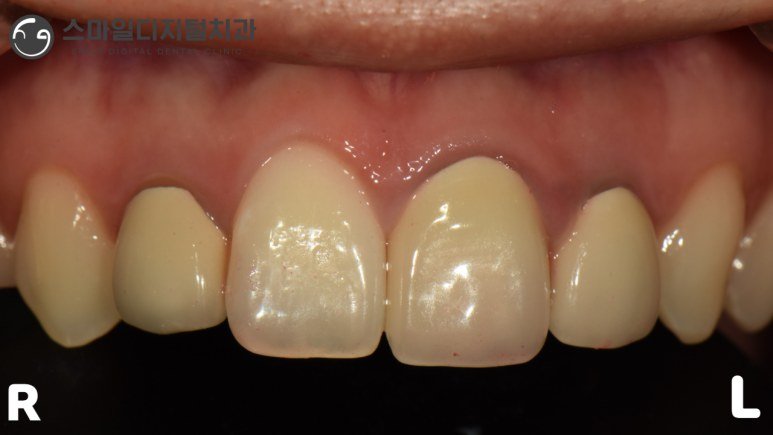
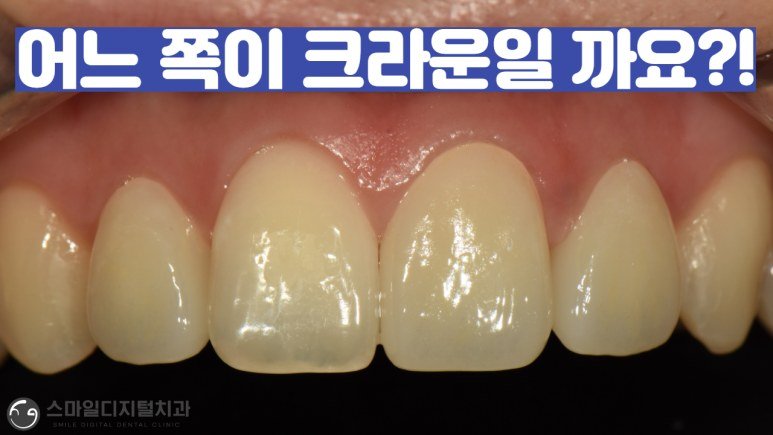
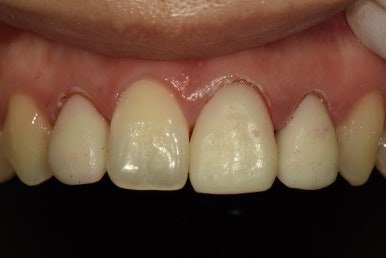
Front view before treatment
The color and margins of my old front tooth crowns bother me.
The patient is a woman in her 20s.
She had previously been treated with crowns on three front teeth, and she visited us because the color of the existing restorations and the gum margin area had begun to bother her over time.
On examination, there was a color difference between the natural tooth and the existing crowns,
and the gum margin of some crowns looked dark.
The existing restorations were PFM (Porcelain Fused to Metal) crowns.
A PFM crown is made by layering porcelain over an inner metal structure.
However, having a PFM crown does not necessarily mean the gums will turn black over time.
Several factors can affect a dark gum margin, such as the inner metal structure, the position of the crown margin, gum recession, the color of the underlying tooth or core, and the condition of the surrounding tissue.
Therefore, rather than checking only the visible color, it is important to evaluate the crown and
the condition of the inner tooth together.
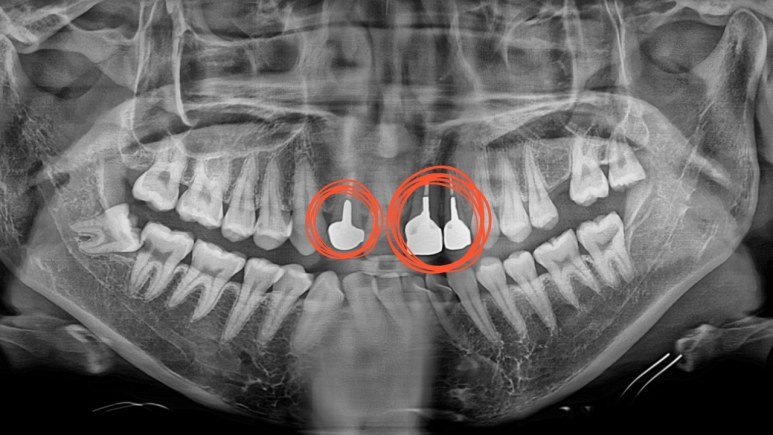
X-ray before treatment
We also checked the condition of the previous root canal treatment on the X-ray.
Before replacing the front tooth crowns, we took an X-ray to check the inner teeth and
the area around the roots.
The teeth under the existing crowns had root canal treatment and posts, and
one tooth showed a radiolucent area around the root tip.
Therefore, in this case, instead of making new crowns right away, we decided to first remove the existing crowns and
posts and then perform root canal retreatment on the teeth that needed it.
In retreatment of front tooth crowns, it is important to check not only the visible shape and color, but also the condition of the previous root canal treatment,
the remaining tooth structure, and the tissue around the roots.
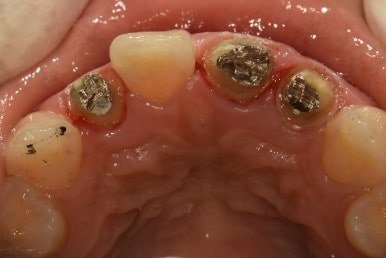
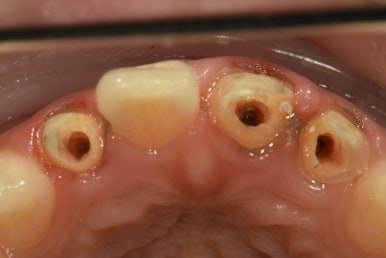
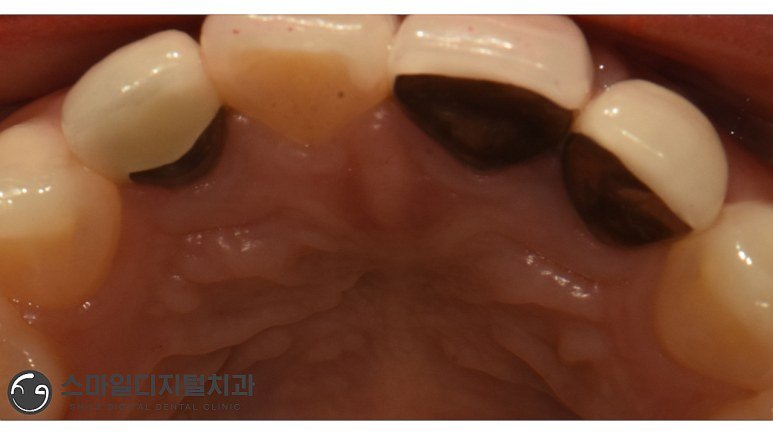
We removed the old crowns and posts and performed root canal retreatment.
We removed the existing PFM crowns and checked the inner condition.
After removing the existing posts, we performed root canal retreatment on the teeth that needed it.
Root canal retreatment is not simply removing the remaining nerve again.
It is a process of removing the filling material from inside the existing canal, checking the length and shape of the canal,
cleaning and disinfecting the inside, and then filling the canal again.
Whether retreatment is possible and its prognosis can vary depending on many conditions, including the previous treatment, whether there is a root fracture,
and the remaining tooth structure and periodontal condition.
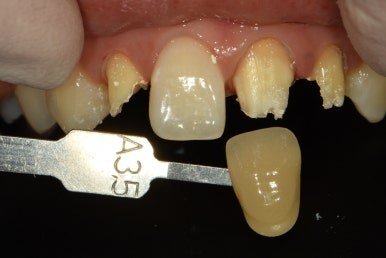
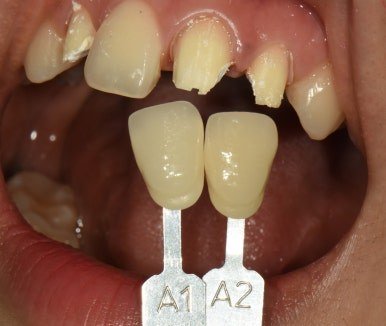
Before and after non-vital tooth bleaching
The darkened front tooth was treated with non-vital tooth bleaching.
A tooth that has had root canal treatment may look darker inside over time.
For this patient as well, we checked the tooth color before making the final front tooth crowns and performed non-vital tooth bleaching twice on the teeth that needed it.
Non-vital tooth bleaching is a method of applying a bleaching agent inside a root canal treated tooth
to change the color of the tooth.
In this case, we checked the color change of the teeth after two bleaching sessions
and then moved on to the next stage of treatment.
Not every root canal treated tooth needs non-vital tooth bleaching,
and the number of sessions and the response can vary depending on the patient and the condition of the tooth.
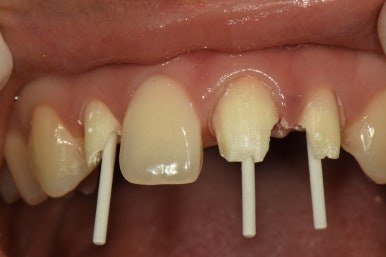
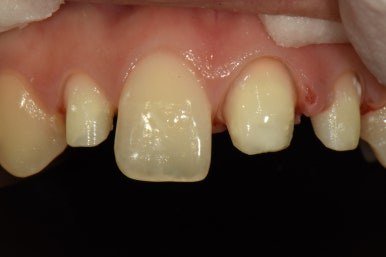
Post and core photo
We rebuilt the post and core to prepare for the crown.
After completing the root canal retreatment and the necessary bleaching, we made the post and
core for the final crown.
A post is not so much a pillar that makes the tooth stronger as
something that can be used, when the remaining tooth structure above the gum is insufficient, to
retain the core for the final crown.
The long-term prognosis of a tooth is not determined by the post alone, but
requires considering several factors together, including the remaining natural tooth structure, the root condition, and the final crown, and
the bite.
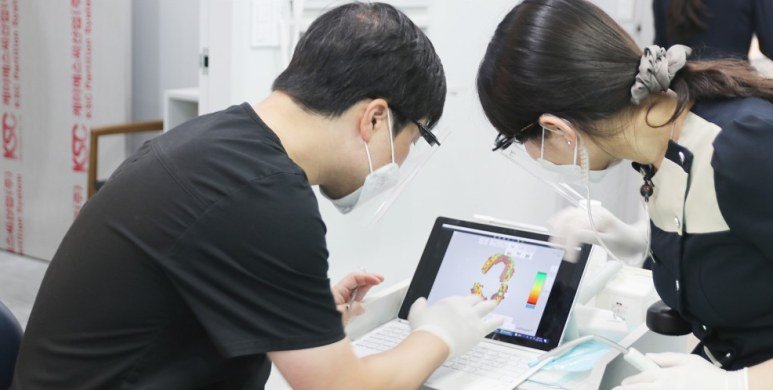
We scanned the front teeth with an intraoral scanner.
After the tooth preparation for the restoration was complete, we used an intraoral scanner
to scan the teeth and surrounding tissue.
In this case, we proceeded with the restoration process using intraoral scan data
instead of impression material.
From the scanned data, we can check not only the shape and margin of the teeth to be treated,
but also their relationship with the adjacent natural teeth.
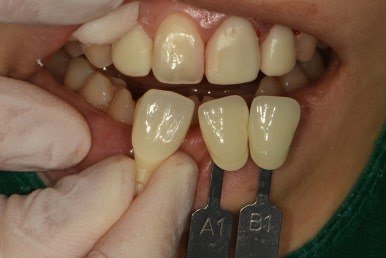
Temporary teeth photo / Shade check photo with our lab technician
We made temporary teeth first to check the shape of the front teeth.
Rather than making the final crowns right away, we first made temporary teeth
and checked the shape in the actual mouth.
What you see in the design on a computer screen and how the front teeth look in the actual mouth
may differ in the points that need to be checked.
Therefore, with the temporary teeth in place, we checked the length and width of the front teeth, left-right symmetry,
tooth axis, and their relationship with the surrounding natural teeth, and made adjustments where needed.
We also checked the patient's opinion during this process.
We checked the shade directly in our in-house dental lab.
For front tooth crowns, harmony in color with the surrounding natural teeth is important as well as shape.
In this case, the dental lab technician in charge of making the restoration in our in-house lab
looked directly at the patient's teeth and checked the shade and the characteristics of the surrounding natural teeth.
We checked in the actual mouth what is difficult to confirm from photos or digital data alone, and exchanged opinions about the desired shape between the doctor, the lab technician, and the patient
before making
the final restoration.
We matched the shape and color to the one natural tooth among the four front teeth.
This was a particularly important part of this case.
Looking at the patient's front teeth, one of the four front teeth was a natural tooth
and the other three were being treated with crowns.
Unlike cases where all of the front teeth are restored with prostheses, when one natural tooth remains,
we need to consider harmony with that tooth in terms of length and width, tooth axis, surface shape,
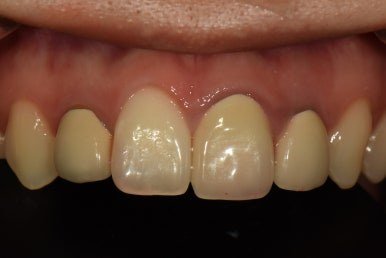
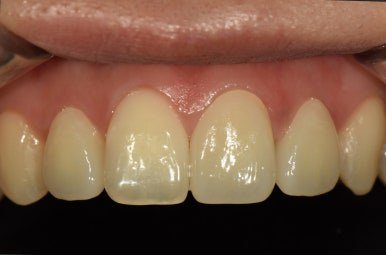
Final Restoration (Before and After)
The final zirconia crowns were placed.
We placed the final zirconia crowns.
After checking the shape with the temporary teeth, we made the final zirconia crowns.
Before placing the final restorations, we checked the shape, color, contact with adjacent teeth, and bite, and made the necessary adjustments.
Before treatment, there was a color difference between the existing PFM crowns and the natural tooth
and the gum margin looked dark in some areas.
After treatment, we can see that after completing the necessary preliminary treatments such as root canal retreatment and non-vital tooth bleaching,
after some time had passed.
You can check this in the photos.
Can an old front tooth crown simply be replaced?
Even if you are not satisfied with the shape or color of your front tooth crowns, it is not always enough to remove the existing crowns
and make new ones.
If a patient already has root canal treatment and posts, as in this case,
the condition of the tooth inside the crown and the area around the root must be checked first.
When necessary, root canal retreatment or retreatment of the post and core may come first, and if the tooth is dark after root canal treatment,
non-vital tooth bleaching may be considered in light of the color of the final restoration.
This patient's course was as follows:
Existing PFM crown examination → X-ray examination → removal of existing crowns and posts
→ root canal retreatment → non-vital tooth bleaching (2 sessions) → post and core → intraoral scan
→ checking the shape with temporary teeth → direct shade check → making zirconia crowns.
We treated her in this order.
In retreatment of front tooth crowns, what matters more than which material to switch to is first checking the condition of the existing tooth, performing the necessary preliminary treatment, and then, considering harmony with the surrounding natural teeth,
planning the final restoration.
Related cases:
Anterior Zirconia Crowns in Seomyeon, Busan: Improving the Shape of the Front Teeth
Front Tooth Crown in Seomyeon, Busan: Non-Vital Tooth Whitening and Gum Surgery Together
Front Tooth Crown Retreatment in Busan Seomyeon: A Case With Root Canal Retreatment and Non-Vital Whitening
Related information: Same-day crown guide · General dental information is also available on the Korean Dental Association.