Hello.
This is Smile Digital Dental Clinic 🙂
When replacing an old front tooth crown, you need to check not only the color and shape of the restoration
but also the condition of the tooth inside the crown and the shape of the surrounding gums.
In particular, when a front tooth has already been lost and replaced with a bridge, the part where a real tooth is present
and the part where there is no tooth may have different gum shapes.
In such cases, rather than only changing the shape of the final restoration, it is important to evaluate the condition of the surrounding soft tissue together
and plan the necessary treatment.
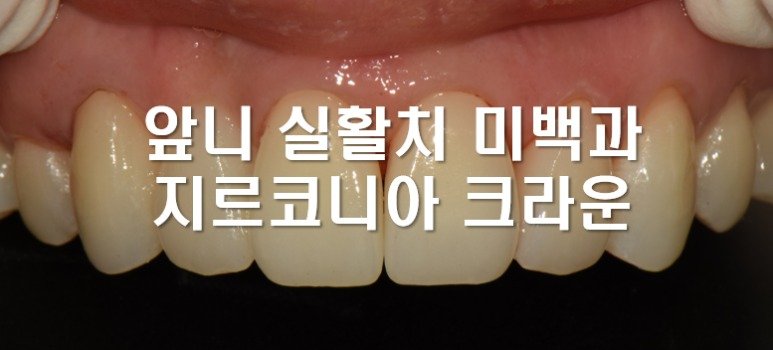
Today, I will introduce a case of a woman in her 40s who visited because she was concerned about the color and shape of her old front tooth restoration,
and who underwent non-vital tooth whitening, periodontal surgery, and gum shape adjustment using a temporary restoration,
and was then retreated with a zirconia restoration.
First, "What is a non-vital tooth?"
It refers to a tooth whose pulp has lost its vitality.^^
In other words, a tooth that has had root canal treatment, or tooth decay (cavities),
or whose nerve has died due to an external impact,
and has therefore lost the vitality of its nerve.
Such non-vital teeth often turn dark in color!
Non-vital tooth whitening can brighten the color! ^.^
What is non-vital tooth whitening?
I will briefly explain the process of non-vital tooth whitening with photos^-^!
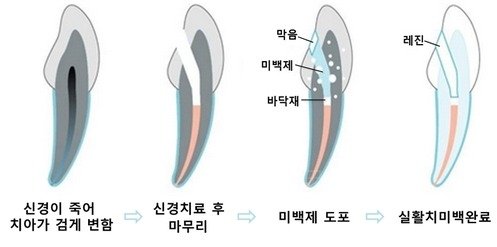
Table of contents
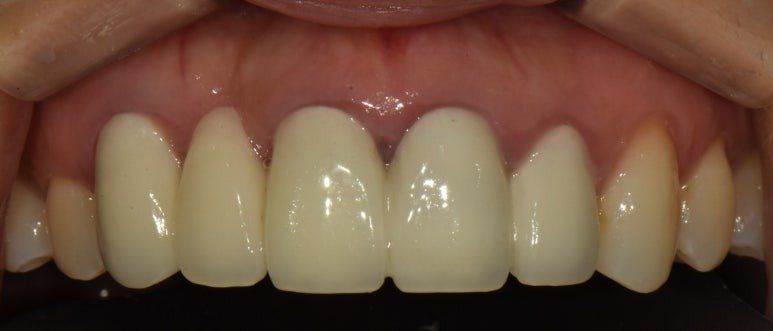
Intraoral photo from the front before treatment
The color and shape of her old front tooth crown did not satisfy her
The patient is a woman in her 40s.
She had been unhappy with the color and shape of her existing front tooth crowns for a long time
and visited us to have the restoration replaced.
Her existing restoration was made up of several connected teeth, and among her front teeth, one had already been lost
and had been restored with a pontic.
A pontic refers to the part that is made and attached to a bridge to stand in for the space where there is no real tooth,
that is, the artificial tooth.
Before treatment, we checked not only the shape and color of the existing restoration but also where the gums at the lost-tooth site
meet the restoration.
What stands out here is that the gums at the lost tooth site on the right side look sunken.
You may not be able to tell right now, but if you look at the treatment process below, you will see the difference^^
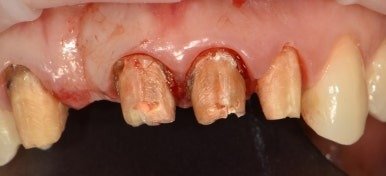
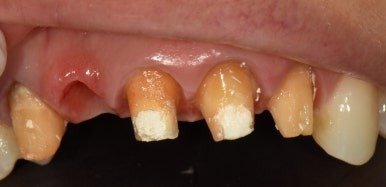
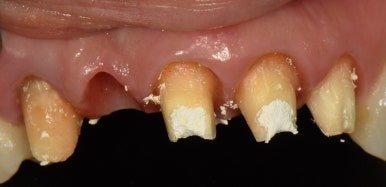
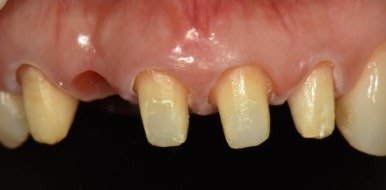
Teeth after removal of the existing restoration
1. Before non-vital tooth whitening / 2. After the 1st whitening session / 3. After the 2nd session / 4. Photo after the whitening agent was removed and the tooth was filled with resin a week later
When we removed the old crown, the tooth had turned dark
After removing the old crown, we checked the condition of the tooth inside.
The tooth that had undergone root canal treatment had turned a dark color.
A tooth whose pulp has lost its vitality like this is called a non-vital tooth.
Discoloration of a tooth can arise from various factors related to pulp necrosis,
past trauma, and root canal treatment.
For this patient, before planning the color of the final front tooth restoration, we decided to perform
non-vital tooth whitening on the discolored tooth.
We adjusted the color inside the tooth with non-vital tooth whitening
Non-vital tooth whitening is a treatment that mainly applies a whitening agent inside a tooth that has had root canal treatment
to induce a color change in the discolored tooth.
For this patient, we proceeded with whitening in stages while checking the color change.
After whitening was finished, we removed the whitening agent, checked the color again about one week later, and restored the area with resin.
Non-vital tooth whitening is not a treatment performed the same number of times on every tooth.
Depending on the cause and degree of discoloration, the condition of the tooth, and the response to whitening,
the number of sessions and the duration can vary.
In this case, after checking the tooth color that changed after whitening,
we continued with the final restorative treatment.
For a front tooth area with no tooth, the gum shape also mattered
What was especially important in this patient's treatment was
the gum shape at the front tooth site where the tooth had already been lost.
A natural tooth has its root surrounded by gum and alveolar bone,
and its crown emerges from the gum.
In contrast, in an area where a tooth has been lost, over time
the shape of the gums can change.
When making a bridge pontic for such an area, it is necessary to consider not only filling the empty space with a tooth shape
but also the shape where the pontic meets the gums,
the volume of the labial gums, and harmony with the surrounding natural teeth.
For this patient, to improve the gums that had sunken after tooth extraction, we planned periodontal surgery
together with soft tissue shape adjustment using a temporary tooth.
We made an incision on the palatal side of the gums and adjusted the labial gum shape with a temporary tooth
In this case, we performed periodontal surgery in which we made an incision on the palatal gums of the lost tooth area
to adjust the soft tissue.
Palatal means the direction of the roof of the mouth, and labial means the direction of the lips.
After surgery, we planned to use the temporary tooth to move and support the adjusted soft tissue labially
and create volume in the gums on the lip side.
Here, the temporary tooth is not simply a tooth used
until the final restoration is completed.
Using the shape of the temporary restoration, it also supported the soft tissue and adjusted the gum shape
of the area where the pontic would be placed.
This process is different from gum contouring, which simply cuts the gums to adjust their height.
It was a process of adjusting the soft tissue in consideration of the existing gum condition, and managing it so that the surrounding tissue healed to fit the desired restoration shape through the temporary tooth.
We planned a shape where the pontic emerges from the gums
A pontic placed in an area with no tooth can be made to rest on top of the gums,
but in some cases, the area that contacts the gums is adjusted into a concave shape
to plan an appearance as if the tooth emerges from the gums.
For this patient as well, to reflect a shape similar to the cervical area of a natural tooth in the restoration,
we adjusted the gum shape of the pontic area using the temporary tooth.
When planning such a shape, it is necessary to consider not only the appearance but also the pressure applied to the gums and the tissue response,
as well as whether hygiene care is possible.
After placing the temporary tooth, we checked the condition of the soft tissue
and evaluated the shape of the area where the restoration would go.
What matters is that the temporary tooth is not meant to press the gums strongly without limit.
While observing the condition of the soft tissue, it is important to adjust
an appropriate shape and contact relationship.
Also, this treatment does not create new roots or alveolar bone
of the lost natural tooth. It is a process of using the remaining soft tissue to adjust the shape
so that the final pontic harmonizes with the surrounding gums.
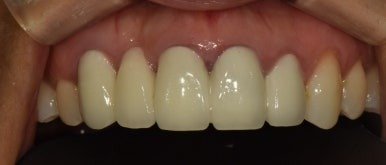
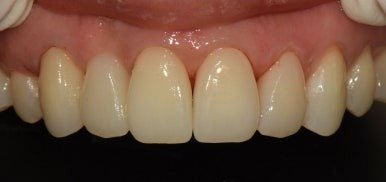
Front tooth zirconia crown replacement
Before zirconia replacement | Zirconia
We placed the final zirconia restoration
Following the treatment plan, we fabricated and placed the final zirconia restoration.
Before treatment, the color and shape of the existing front tooth restoration were the patient's concern.
During treatment, we performed non-vital tooth whitening on the discolored tooth, and for the lost tooth area,
we adjusted the shape of the soft tissue using periodontal surgery and a temporary tooth.
For the final restoration, we considered not only the color and shape in harmony with the remaining natural teeth but also how the pontic
connects with the gums.
This case is meaningful not as a simple replacement of an old crown with a new zirconia one,
but because both the internal color of the tooth and the gum shape of the lost area were considered
and the restoration was remade.
Why the gum shape must be checked when retreating a front tooth bridge
An area where a front tooth has already been lost and an area where natural teeth remain
may require different approaches to planning the restoration.
In particular, if the alveolar bone and gums at the lost area have shrunk,
there may be limitations on the length or shape of the final restoration.
In this case, by evaluating the condition of the remaining soft tissue and alveolar bone,
it must be judged whether the shape can be adjusted with a temporary restoration alone, or whether
additional treatment such as periodontal surgery or soft tissue grafting is needed.
Also, a pontic that closely contacts the gums
needs a structure that can be cleaned with interdental brushes or floss.
Rather than making a pontic with only a natural appearance in mind,
long-term hygiene care and the condition of the surrounding tissue should also be examined.
Summary of the treatment process
This patient visited to improve the color and shape of her old front tooth restoration.
The treatment process was as follows.
Checking the condition of the existing front tooth restoration → Removing the crown → Non-vital tooth whitening of the discolored tooth
→ Checking the color after whitening → Palatal gum incision at the lost area and soft tissue adjustment
→ Adjusting labial gum volume and the pontic area shape with a temporary tooth
→ Checking the shape and color of the final restoration → Placing the zirconia restoration
When retreating a front tooth restoration, it is important to consider not only changing the color of the crown
but also the condition of the remaining teeth, the gum shape of the lost area,
the structure of the final restoration, and hygiene care.
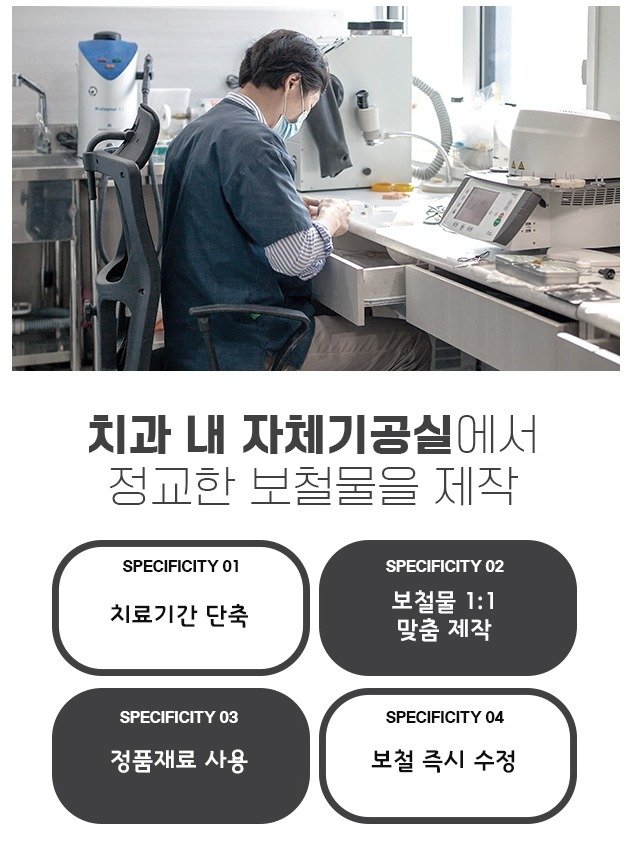
We checked the shape and color of the final restoration in our in-house dental lab
After going through non-vital tooth whitening and gum shape adjustment, we planned the final restoration.
In a front tooth restoration, it is necessary to consider not only the length, width, and alignment of the teeth but also the color and
translucency of the surrounding natural teeth and their relationship with the gum line.
For this patient, we worked with the manager who is in charge of making restorations in our in-house dental lab
and checked the shape and color together.
In particular, for the area where the tooth had been lost, it was important to reflect the shape of the pontic confirmed with the temporary tooth
and its relationship with the surrounding gums in the final restoration design.
We reviewed the shape of the existing connected restoration and distinguished the areas where real teeth remained from the areas where a pontic was
needed, and made the restoration according to the conditions of each area.
We fabricated the restoration.
The photos of the treatment process and before and after treatment in this case are posted with the patient's consent.
Treatment methods and results vary from person to person. The effect of non-vital tooth whitening can differ depending on the cause of discoloration and the condition of the tooth, and re-discoloration or side effects inside the tooth or around the root may occur. After periodontal surgery, pain, bleeding, swelling, infection, and gum recession may occur, and the volume and shape of the soft tissue may not be maintained as planned. Whether the shape of a pontic area can be adjusted depends on the condition of the remaining soft tissue and alveolar bone, so it should be decided after sufficient examination and consultation.
#BusanFrontToothCrown #SeomyeonFrontToothCrown #FrontToothCrown #FrontToothCrownRetreatment #BusanNonVitalToothWhitening #SeomyeonNonVitalToothWhitening #NonVitalToothWhitening #FrontToothDiscoloration #FrontToothZirconia #ZirconiaCrown #FrontToothBridge #BridgeRetreatment #FrontToothPontic #Pontic #PeriodontalSurgery #GumShapeAdjustment #FrontToothGumSurgery #InHouseDentalLab #SeomyeonDental #SmileDigitalDental
Related cases:
Front Tooth Crown Retreatment in Busan Seomyeon: A Case With Root Canal Retreatment and Non-Vital Whitening
Front Tooth Crown in Busan Seomyeon: Retreating an Old PFM Crown with a Zirconia Crown
Seomyeon, Busan Front Tooth Crown: Re-Treating a Root-Only Tooth While Preserving It
Related information: Same-day crown & one-day restoration guide · General dental information is also available on the Korean Dental Association.