Hello.
From the heart of Seomyeon,
drawing tomorrow's smile,
This is Smile Digital Dental Clinic 🙂
Among people who have worn a full denture for many years,
“Can't I stop using the denture and be treated with implants now?”
is a question some patients ask.
However, when teeth have been missing for a long time, the amount and shape of the alveolar bone may have changed, and especially in the upper back teeth area, the implant treatment plan can differ because of the relationship between the sinus and the remaining alveolar bone.
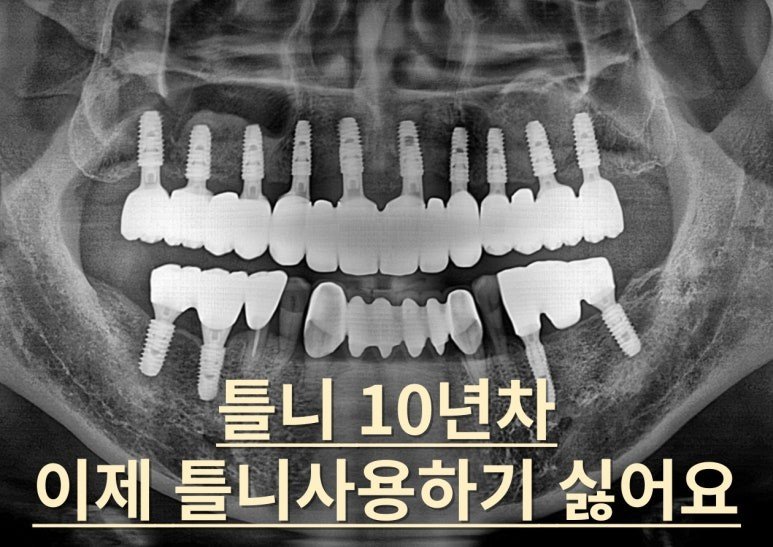
Today we introduce the case of a man in his 70s who had worn an upper full denture for more than 10 years,
treated with upper full-arch implants together with a sinus lift.
What Is a Sinus Lift?
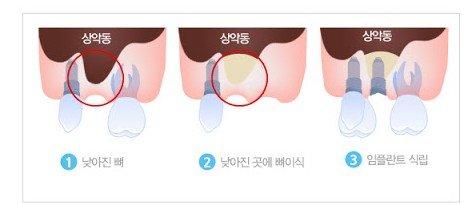
Above the upper jaw bone there is an empty space without bone, called the maxillary sinus (an air-filled space).
An implant works as its whole root fuses with the jawbone,
so if an implant is placed in the sinus, it is exposed not to the jawbone but
to the empty space of the sinus,
and the implant fails.
So we perform a bone graft in the empty sinus space to build up jawbone there,
and this is called a sinus lift.
Table of contents
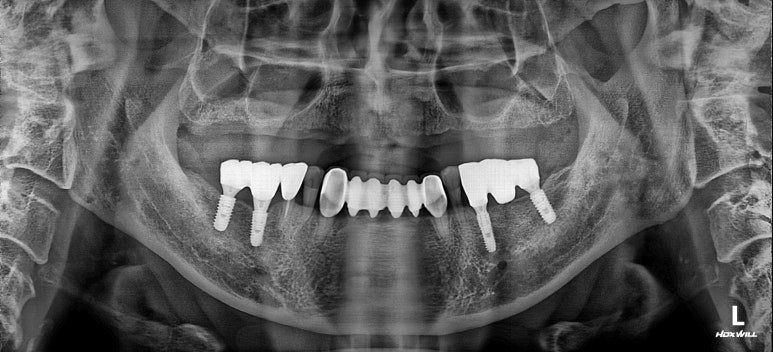
Panoramic X-ray before treatment
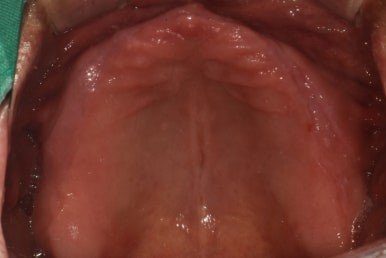
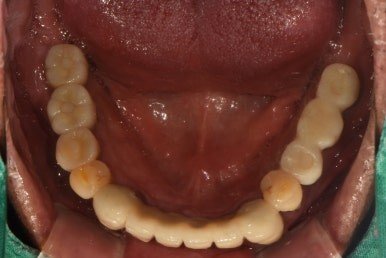
Intraoral photos before treatment
I Used a Full Denture for Over 10 Years
He is a man in his mid-70s.
On the lower jaw he had previously been treated with implants and a bridge, and on the upper jaw he was using a full denture.
He had worn the full denture for more than 10 years.
The patient felt discomfort from wearing the denture for so long, and said that if possible he wanted the upper jaw
to be treated with a fixed implant prosthesis as well.
He had also consulted his previous dental clinic about full-arch upper implants, but according to the patient, because the bone volume in the upper back teeth area was insufficient, he was advised to place implants in the front and
use a partial denture in the back.
But the patient wanted to check again whether there was a treatment method that would let him stop using a denture, so he visited Smile Digital Dental Clinic.
Why Can Implant Treatment Be Difficult in the Upper Back Teeth?
Above the upper back teeth there is an air-filled space called the maxillary sinus.
After teeth are lost, as time passes the height of the alveolar bone may decrease, or the sinus may expand downward,
and in that case there may not be enough bone height to place implants.
The same method is not applied to every patient.
We check the height and width of the remaining bone, the shape of the sinus, general health, the required implant positions and so on, and then judge whether implants can be placed and whether bone grafting is needed.
For this patient, we checked the relationship between the sinus and the remaining
alveolar bone not only with a panoramic X-ray but also with 3D CT.
The examination showed that the bone height in the upper back teeth area was limited, so for that area we planned implant treatment together with a sinus lift and
bone graft.
We Planned the Full-Arch Implants With CT and an Intraoral Scan.
In full-arch implants, rather than looking at each implant separately, it is important to consider together the position and bite of the final prosthesis, the distribution of the implants, and the surrounding anatomical structures.
For this patient as well, we planned the position and direction of the implants
based on 3D CT and intraoral scan data.
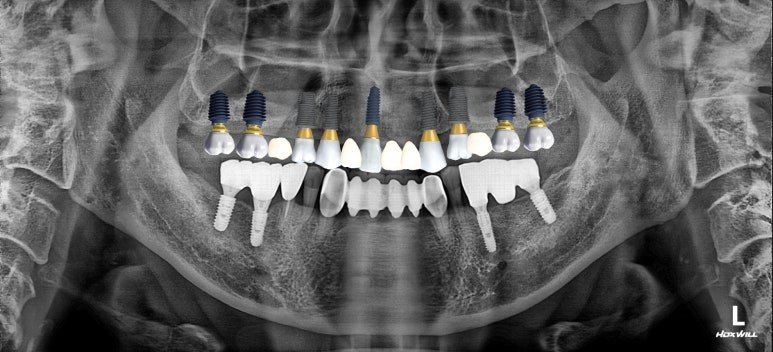
When consulting with the patient, we marked the planned positions and number of implants on a panoramic X-ray and
explained the treatment plan.
we provided materials so that he could review the treatment plan again at home with his family.
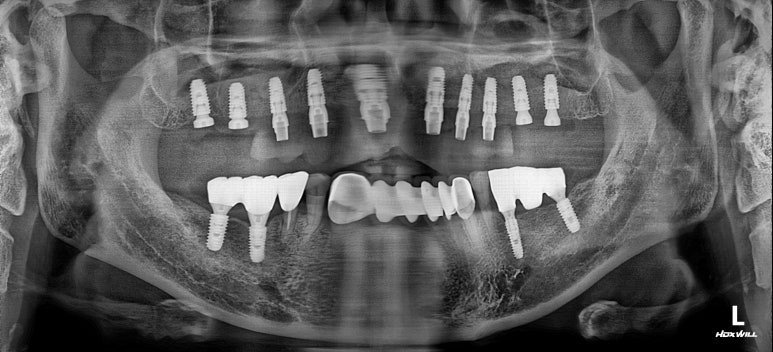
Panoramic X-ray on the day of surgery
We Placed the Implants and Performed the Sinus Lift on the Same Day.
We explained the extent of surgery and the treatment process to the patient, and in this case, according to the plan,
we placed the upper implants and performed the sinus lift and bone graft in the necessary areas on the same day.
This is the panoramic X-ray after surgery.
In the upper back teeth area, we placed implants together with a sinus lift and bone graft, and for some implants including those in the front, after checking their stability at surgery and the overall conditions, we decided to use them
for the temporary prosthesis.
There is something important here.
Using a digital guide does not mean that
temporary teeth can be connected on the day of surgery for every patient.
Whether a temporary prosthesis is possible on the day depends on the initial stability of the implants, the condition of the bone, the positions and distribution of the implants,
whether bone grafting was done, the bite, and the patient's general condition, which must be evaluated together.
After evaluating these conditions, for this patient we connected
temporary teeth from the front teeth to the premolar area.
On the other hand, in the back molar area where a sinus lift was done, during the initial healing period
we left it out of the temporary prosthesis to reduce unnecessary load.
What Role Did the Digital Guide Play?
In this treatment, we planned the implant positions and directions in advance using CT and intraoral scan data, and
used a guide to reflect this in the surgery.
A digital guide is a device that helps transfer the implant positions and directions planned on the computer
to the actual surgery.
However, because it is a navigation implant, it is not appropriate to say that implants are placed
accurately without any error.
Because differences can occur in the actual placement position even in digital guided surgery,
we plan by considering the anatomical structures and bone condition seen on CT,
and it is important to check clinically during surgery as well.
Instead of the Full Denture He Used for Over 10 Years, He Now Had Temporary Teeth.
I think this was the part that felt biggest to the patient.
After using an upper full denture for more than 10 years, he had felt discomfort from a denture covering the palate, and
in this case, after checking his condition following surgery, we were able to connect a fixed temporary prosthesis.
However, the fact that temporary teeth were connected on the day of surgery
does not mean he could chew all foods as usual right away.
While the implants are healing with the surrounding bone, care must be taken with the type of food and how to chew so that excessive force is not applied to the temporary prosthesis, and
the bite and
the condition of the temporary prosthesis must be checked regularly.
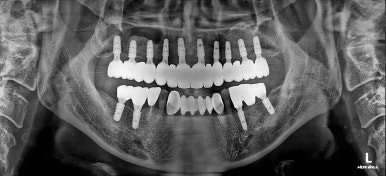
Final panoramic X-ray
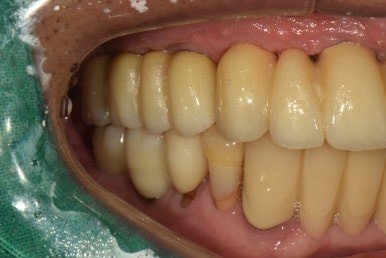
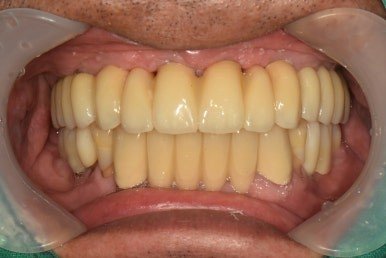
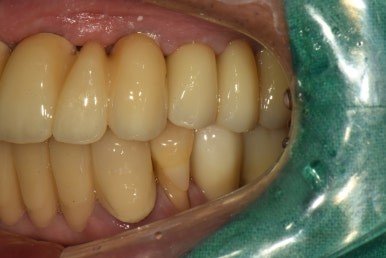
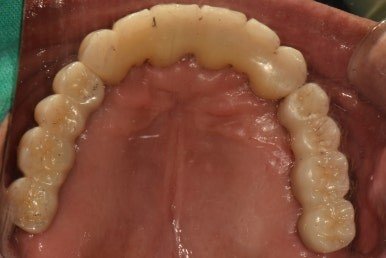
Photos of the final prosthesis
After Healing, We Made the Final Upper Full-Arch Implant Prosthesis.
After the sinus lift and implant placement, we proceeded with prosthetic treatment while checking the healing process.
In the end, using the implants at the planned positions,
we completed a fixed implant prosthesis for the upper jaw.
In this case, while making the implant superstructure and the final prosthesis, we checked the position of each implant and
the bite, the shape of the prosthesis, and so on.
Before treatment he was using an upper full denture, but after treatment we can see the change to an implant-supported
fixed prosthesis.
If the Sinus Bone Is Insufficient, Can't You Have Full-Arch Implants?
Just because the bone volume in the upper back teeth area is insufficient, not every patient
is unable to receive implant treatment.
Conversely, having a sinus lift does not make full-arch implants possible in every case either.
Many conditions must be checked, such as the height and width of the remaining alveolar bone, the condition of the sinus, the required implant positions, systemic diseases and medications, and smoking.
This patient's course was as follows:
using an upper full denture for more than 10 years → panoramic X-ray and 3D CT examination
→ checking the bone volume in the upper back teeth and the sinus → full-arch implant planning
→ sinus lift and bone graft with implant placement → temporary prosthesis in the range where conditions were confirmed
→ final fixed implant prosthesis after healing
in that order.
If you have used a denture for a long time and have been told that your jawbone is insufficient,
rather than judging in advance that you must keep using a denture or, conversely, that full-arch implants are definitely possible,
it is important to check the remaining bone and the condition of the sinus with CT, and then
consider the possible treatment methods.
Aftercare Is Also Important for Full-Arch Implants
Implants themselves do not get cavities like natural teeth,
but inflammation can occur around implants as well.
If inflammation progresses in the tissue around an implant, it can affect the surrounding bone too,
so even after treatment is finished, the implants, prosthesis and surrounding gums must be checked regularly.
Rather than setting the checkup interval at 6 months for every patient,
it is better to adjust it according to the patient's periodontal condition, oral hygiene, the condition of the implants and prosthesis, and
risk factors.
In particular, with full-arch implants it is important to learn how to clean under the prosthesis and
to maintain it regularly.
The photos of the treatment process and before and after treatment in this case are posted with the patient's consent.
Treatment methods and results of implants and sinus lifts vary from person to person. Depending on bone volume and quality, the shape of the sinus, systemic diseases and medications, smoking and the healing condition, bone grafting or additional surgery may be needed, and implant treatment may be difficult in some cases. After a sinus lift, bleeding, swelling, pain, infection and sinus-related complications may occur, and implants may also develop inflammation of the surrounding tissue or prosthesis-related problems after treatment, so regular care is needed.
Related cases:
Full-Arch Implants in Seomyeon, Busan: A Case of a Patient in Her 70s Treated With a Digital Guide
Full-Arch Implants in Seomyeon, Busan: A Patient From Ulsan With Same-Day Temporary Teeth
Full Implants With a Digital Guide in Busan Seomyeon: A Case of a Man in His 70s
Related information: Full-Arch Implants in Seomyeon · Digital guided implant information · General dental information is also available on the Korean Dental Association.