Hello.
From the heart of Seomyeon,
drawing tomorrow's smile,
this is Smile Digital Dental Clinic 🙂
Having wisdom teeth does not mean they all have to be removed.
If they have erupted normally above the gum, cause no problems for the neighboring teeth, and
can be kept clean, there are cases where they can be kept and monitored.
On the other hand, if a wisdom tooth has only partially erupted or is positioned at an angle, causing repeated
inflammation of the surrounding gums, food impaction, or decay in the wisdom tooth or the adjacent molar,
extraction may be considered.
In particular, for lower wisdom teeth, there are cases where the relationship with the mandibular canal,
through which the inferior alveolar nerve runs, needs to be checked.
Today, I will introduce the case of a woman in her 20s who had a problem found around a wisdom tooth during a check-up,
had the positional relationship between the wisdom tooth and the inferior alveolar nerve canal checked with 3D CT,
and then had the tooth extracted.
Table of contents
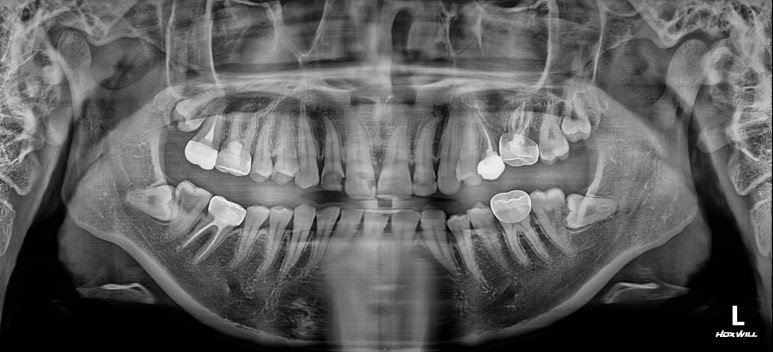
Initial panoramic X-ray
A problem around a wisdom tooth was found during a check-up
The patient is a woman in her 20s.
She did not come because of pain in a particular tooth, but for an overall
oral check-up.
The examination showed wisdom teeth in both the upper and lower jaws, and the eruption status of each
and the condition of the surrounding tissue differed.
Some wisdom teeth were impacted in the gum, but there were no particular signs of inflammation or need for treatment at that time, so we decided to monitor them.
On the other hand, the lower right wisdom tooth was partially exposed in the mouth, and when we checked the surrounding gum condition and
the adjacent tooth, extraction needed to be considered.
The important point here is that we did not extract all the wisdom teeth just because they were there,
but evaluated the condition of each wisdom tooth separately.
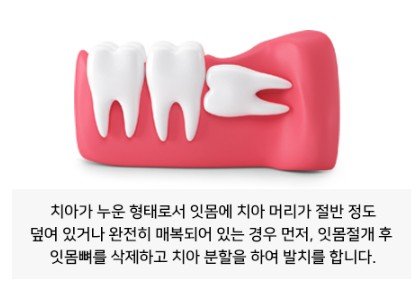
Why can a partially erupted wisdom tooth be a problem?
When a wisdom tooth has not fully erupted and only part of it is out of the gum,
it can be hard to clean around it with a toothbrush.
Food and plaque tend to collect between the wisdom tooth and the molar in front of it, and the surrounding gums
may become inflamed, or decay may develop in the wisdom tooth or the adjacent tooth.
For this patient as well, after checking the swelling of the gum around the wisdom tooth and the condition of decay in the adjacent area, we explained the need for extraction.
Typical cases in which wisdom tooth extraction is considered include repeated inflammation or pain around the wisdom tooth, decay, effects on adjacent teeth, and conditions that are difficult to keep clean.
However, having orthodontic treatment is not by itself a reason to extract every wisdom tooth,
and the orthodontic treatment plan and the position of the wisdom teeth must be evaluated together.
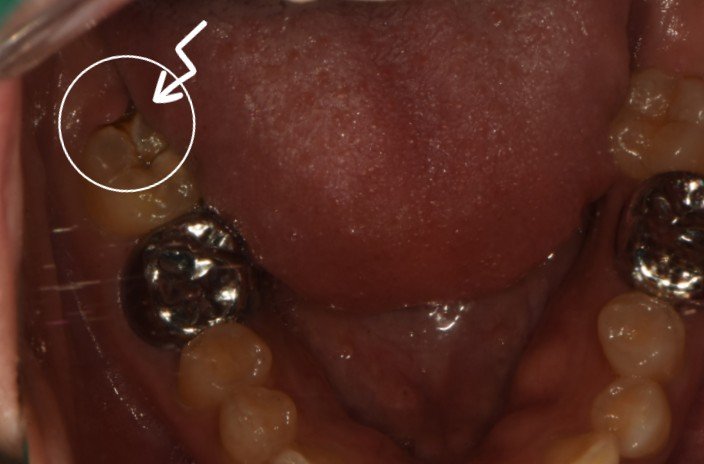
In this patient's case, if you look at the arrow,
the gum toward the molar is swollen
and you can see that the tooth is decayed.
If the wisdom tooth is not completely buried
and has only partially erupted, as in the photo,
the gum swells and food gets trapped toward the gum, making it hard to keep clean,
which can also affect the tooth in front of it!
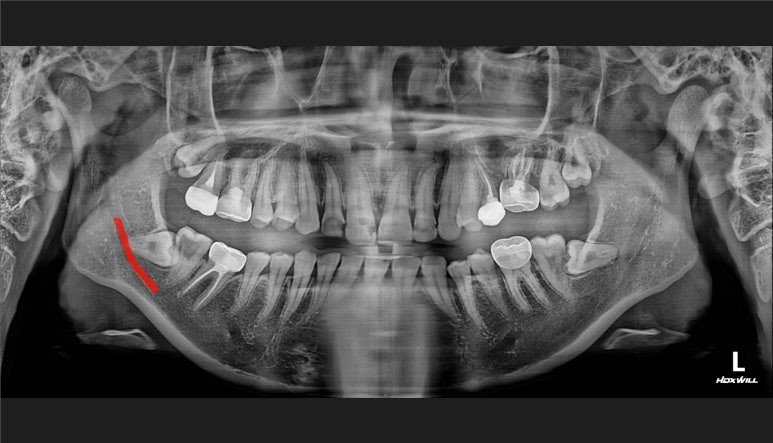
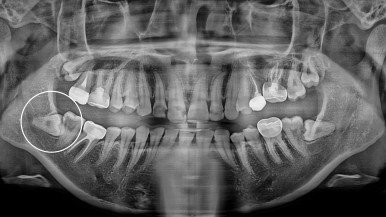
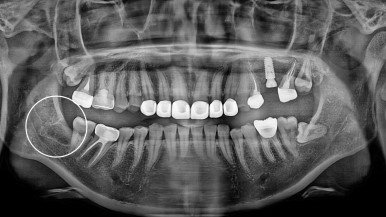
Wisdom tooth and mandibular canal marked on the panoramic X-ray
A lower wisdom tooth requires checking its relationship with the inferior alveolar nerve.
Inside the lower jaw, there is the mandibular canal, through which the inferior alveolar nerve,
which is involved in sensation of the lip and chin area, runs.
When the root of a lower wisdom tooth is close to the mandibular canal, it is important to check the
positional relationship between the two structures before extraction.
A panoramic X-ray helps us check the overall direction and position of the wisdom tooth,
but because it is a two-dimensional image, when necessary we use 3D CT to
additionally check the three-dimensional relationship.
For this patient, we judged that the relationship between the lower right wisdom tooth and the mandibular canal needed to be checked
in more detail on the panoramic X-ray, so we performed a CT scan.
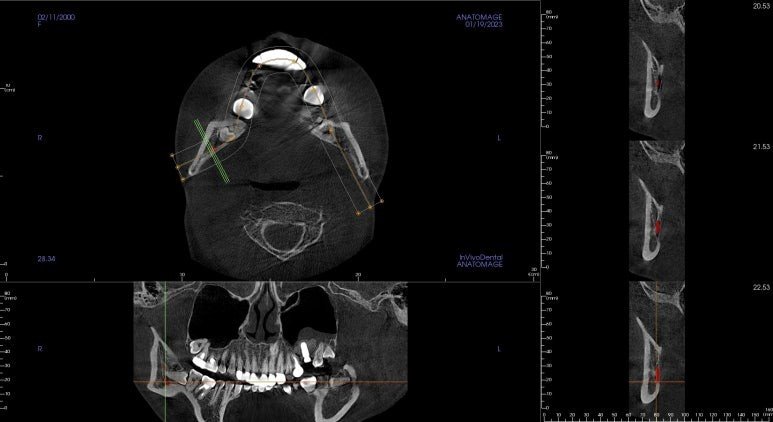
Wisdom tooth and mandibular canal marked on the CT
We checked the position of the wisdom tooth and the nerve canal with 3D CT.
On the 3D CT, we checked the positional relationship between the root of the wisdom tooth and the mandibular canal from several directions.
The purpose of this examination is not simply to check a single number for how many mm away the nerve is.
We use it to check the shape and direction of the wisdom tooth root and its three-dimensional relationship with the surrounding alveolar bone and the mandibular canal, and to plan the extraction method.
When the root of the wisdom tooth is close to the inferior alveolar nerve, the possibility of nerve damage
during extraction must be considered.
If the nerve is affected, reduced sensation or abnormal sensation may occur in areas such as the lower lip or chin,
and although most cases recover, in rare cases the symptoms may
persist for a long time, so a sufficient explanation to the patient before extraction is necessary.
How is an impacted wisdom tooth extracted?
The extraction method varies depending on the position of the wisdom tooth.
For a wisdom tooth that is partly or completely covered by gum and bone, it may be necessary to make an incision in the gum within the necessary range
and expose the wisdom tooth.
If the tooth is lying at an angle or is difficult to remove in one piece,
the wisdom tooth may be divided into several parts and removed.
Depending on the case, part of the surrounding alveolar bone may also need to be removed.
What matters is not to simply judge that an extraction without any bone removal is a good extraction, but to perform the surgery while reducing damage to the surrounding tissue, considering the position and shape of the wisdom tooth,
within the necessary range.
For this patient as well, we performed the extraction with reference to the position of the wisdom tooth
and the surrounding structures confirmed on the CT.
The wisdom tooth extraction is complete
In the photo after extraction, you can see the area where the wisdom tooth used to be.
After a wisdom tooth is extracted, this space is not immediately filled with bone;
instead, a blood clot forms and the soft tissue and bone heal in sequence.
Right after extraction, it is important to be careful so that this blood clot is kept stable.
What to watch out for after wisdom tooth extraction
1. For at least 2 hours after extraction
Bite firmly on the gauze.

In most cases, bleeding stops after
biting on the gauze for about 2 hours.
If bleeding does not stop and blood keeps flowing,
it is better to bite on the gauze
for about 1 hour more.
2. Apply ice packs for 48 hours.

For 48 hours after extraction,
holding the ice pack you received at the clinic
against your face greatly helps to reduce swelling and
pain.
The best method is
cold compresses of 10 minutes on,
10 minutes off.
3. Be sure to finish the prescribed medication.

If you do not take antibiotics for the full prescribed period,
antibiotic resistance may develop
and the extraction site may not heal well,
so please be sure to finish them.
4. Avoid smoking, alcohol,
and using straws after extraction!

If you smoke or suck on a straw,
negative pressure forms in the mouth
and bleeding may not stop well.
Smoking and alcohol can interfere with healing
or cause side effects,
so please be careful for at least 7 days.
Do all wisdom teeth have to be removed?
Not necessarily.
This patient also had several wisdom teeth,
but not all of them were extracted at the same time.
We decided whether to extract each one after checking its eruption direction and position, the condition of the surrounding gum, the effect on decay and adjacent teeth,
and whether it could be kept clean.
In particular, when a lower wisdom tooth appears close to the inferior alveolar nerve canal, CT can be used as needed
to check the three-dimensional positional relationship before planning treatment.
This patient's course was as follows:
full oral check-up → checking the wisdom teeth and surrounding teeth → evaluating the need for extraction
→ checking the panoramic X-ray → checking the relationship between the mandibular canal and the wisdom tooth with 3D CT
→ extraction planning → extraction of the impacted wisdom tooth → post-extraction care
We treated her in this order.
Rather than extracting a wisdom tooth simply because it is there, it is important to decide by checking whether it is currently causing problems,
whether it may affect the surrounding teeth in the future, and how it
relates to the surrounding anatomical structures during extraction.
The photos of the treatment process and before and after treatment in this case are posted with the patient's consent.
The need for wisdom tooth extraction and the surgical method may vary depending on the position and direction of the wisdom tooth, the degree of impaction, and its relationship with the adjacent teeth, alveolar bone, and nerve canal. After extraction, pain, swelling, bleeding, infection, and dry socket may occur, and in the case of lower wisdom teeth, sensory changes related to the inferior alveolar nerve or lingual nerve may rarely occur. The decision on treatment should be made after sufficient examination and consultation.
Related cases:
Gum Treatment in Seomyeon, Busan: A Case of Bleeding and Swollen Gums
Root Canal Retreatment in Seomyeon, Busan: A Long-Term Follow-Up Case Preserving the Natural Tooth
Same-Day Inlay in Seomyeon, Busan: A Case of Treating Cavities in One Day
Related information: View other treatment cases · General dental information is also available on the Korean Dental Association.