Hello.
From the heart of Seomyeon,
drawing tomorrow's smile,
This is Smile Digital Dental Clinic 🙂
If a front tooth breaks off badly near the gum line,
does the tooth always have to be extracted and replaced with an implant?
When a tooth is severely fractured, extraction is sometimes necessary.
However, after evaluating the fracture location, the condition of the root, the remaining tooth structure, the periodontal tissue and the status of the previous root canal treatment,
there are also cases in which treatment to preserve the natural tooth can be considered.
Today I will introduce a case of a woman in her 20s who came in for an implant consultation after a front tooth was badly broken,
who underwent intentional replantationand was then restored with a crown.
Table of contents
I was thinking about an implant after my front tooth broke.
The patient is a woman in her 20s.
She came in after her upper left front tooth broke badly and the fractured piece had been
temporarily bonded back on at another dental clinic.
She had previously been told that the tooth needed to be extracted, and even at her first visit
she believed that, rather than a treatment to keep the natural tooth,
she would have to have it extracted and replaced with an implant.
However, for a highly visible tooth such as a front tooth, the decision to extract is not made
just because it is broken.
We need to check how far the fracture extends, whether there is any crack or fracture in the root,
and whether the remaining tooth can be restored again.
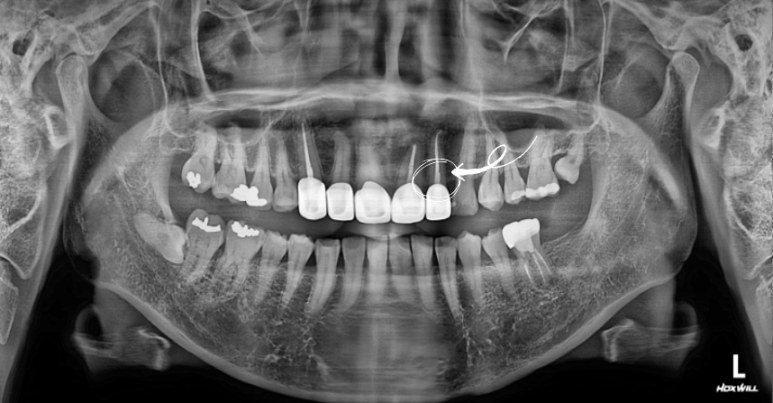
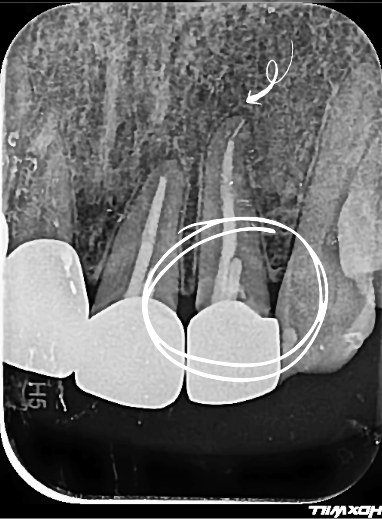
First-visit X-ray
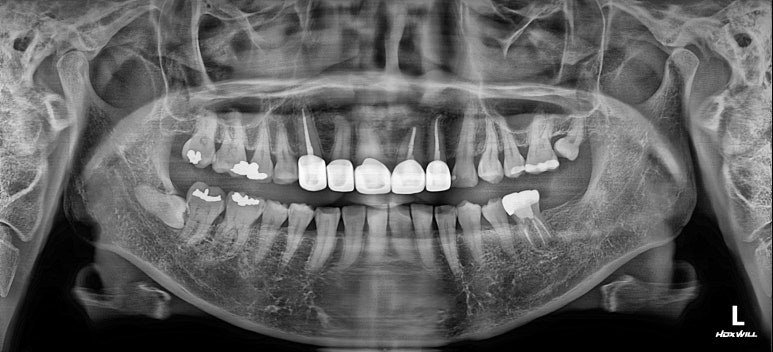
We also checked the condition of the previous root canal treatment on the X-ray.
The tooth had already received root canal treatment in the past.
On the X-ray, an instrument that appeared to have broken during the earlier treatment remained inside the root canal, and a radiolucency was seen around the root tip.
Because the tooth was also severely fractured, we also had to judge whether the remaining root could be used
to provide prosthetic treatment again.
Fortunately, based on the examination results, we judged that in this case a treatment method to preserve
the natural tooth could be considered.
After explaining the various treatment options and their limitations to the patient, we decided to perform intentional replantation (intentional replantation).
What is intentional replantation?
Tooth replantation is a treatment method in which a problem tooth is carefully extracted,
the root is examined directly outside the mouth and the necessary root-end treatment is performed,
and the tooth is then placed back in its original position.
It is not a treatment performed on every root-canal-treated tooth.
It can be chosen when general non-surgical retreatment or apical surgery is difficult to apply,
or when replantation can be considered after comparing the various treatment methods,
in limited cases.
The shape of the root, whether it is fractured, the condition of the periodontal tissue, and
whether the tooth can be removed without damage during extraction are also important.
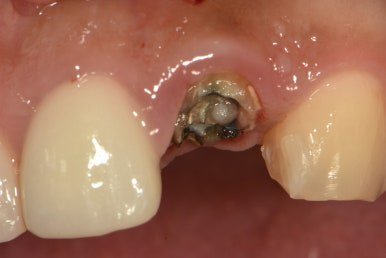
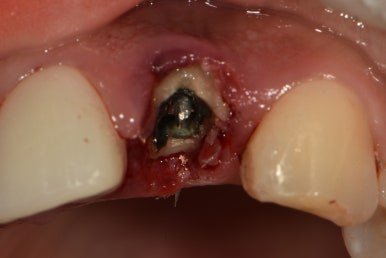
Photo after removing the fractured crown portion
We removed the fractured crown portion and examined the remaining root
This shows the fractured part that had been temporarily attached after it was removed.
A considerable part of the crown was lost, so tooth structure remained mainly in the root.
Considering the condition of the remaining tooth and the possibility of restoring it later,
we proceeded with replantation as planned.
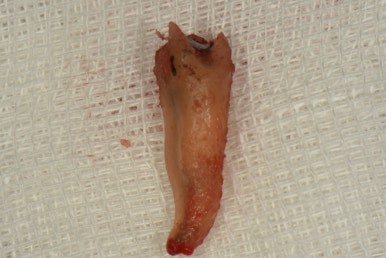
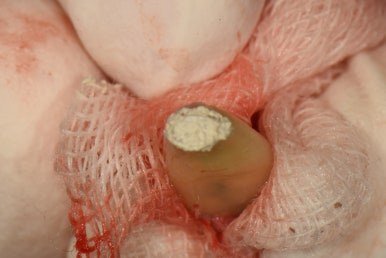
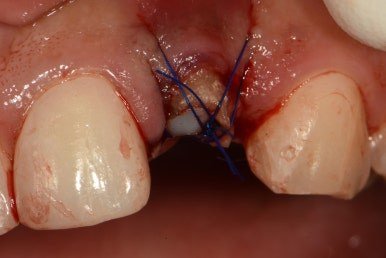
Extracted tooth / Root-end treatment photo / Intraoral photo right after replantation
We extracted the tooth and treated the root tip
We extracted the tooth carefully, minimizing damage to the root and surrounding tissue.
After examining the root directly outside the mouth, we performed the necessary treatment at the root tip
and carried out a root-end filling using MTA.
In intentional replantation, it is important to reduce damage to the periodontal ligament cells
on the root surface of the extracted tooth.
Therefore, we keep the time the tooth is outside the mouth as short as possible
and carry out the treatment carefully so that the root surface is not unnecessarily dried out or damaged.
In this case, the tooth was replanted in a different orientation
This patient's treatment had one distinctive feature.
Because the crown was severely fractured and it was difficult to secure tooth structure for a future crown,
in this case we rotated the tooth 180 degrees from its original orientation
and replanted it.
This is not a method used in every tooth replantation.
It was chosen considering this patient's fracture location, root shape, remaining tooth structure, and
the possibility of future restoration.
Therefore, it should not be generalized to mean that any broken tooth can be saved by turning it and replanting it.
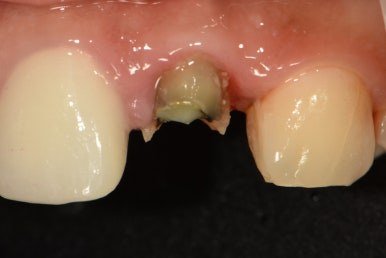
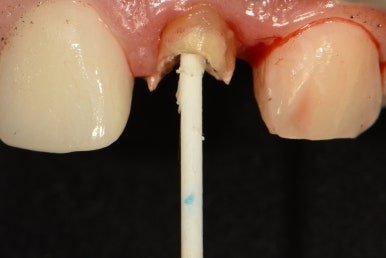
Photo of healing after replantation / Photo of the post and core process
We checked the healing after replantation
After replanting the tooth, we did not make the final crown right away,
but checked the progress of the tooth and surrounding tissue.
About a month later, we checked the condition through the clinical findings and X-rays,
and examined the replanted tooth and surrounding tissue again.
After replantation, it is important to continuously monitor not only pain and mobility but also changes in
the root and periodontal tissue.
After checking the condition, we decided to proceed with the final prosthetic treatment.
We restored the remaining tooth structure to prepare for the crown
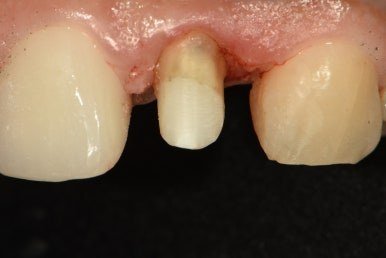
In this patient, the remaining crown tooth structure was insufficient because of the fracture.
Therefore, we carried out the restorative steps needed to build and retain a core
for making the final crown.
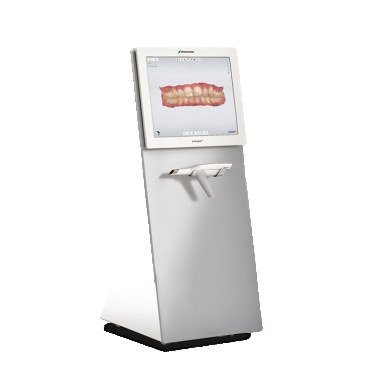
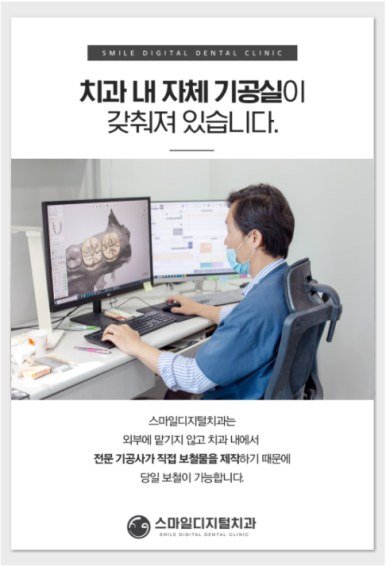
Intraoral scan photo / Digital design
We made the final crown after an intraoral scan
In the prosthetic stage, we scanned the teeth and surrounding tissue with an intraoral scanner.
Using the scanned data, we designed the shape of the crown and made the final restoration considering the length and shape of the neighboring front teeth,
the color and the bite.
The in-house digital lab process has the advantage that, without transporting impressions to an outside dental laboratory,
prosthesis design and fabrication can continue directly from the scan data.
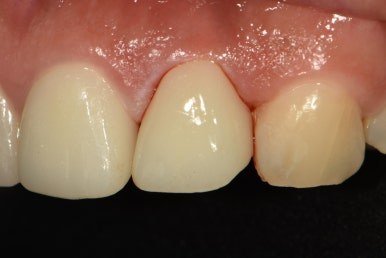
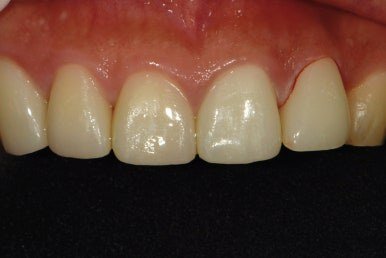
Photo of the final crown
We placed the final front tooth crown.
After checking progress following the replantation, we finally placed the crown.
Because it is a front tooth, we made the restoration considering its length, width, shape and color
in harmony with the neighboring teeth.
However, with replantation, the treatment is not completely finished once the crown is placed.
It is especially important to check the long-term progress after treatment.
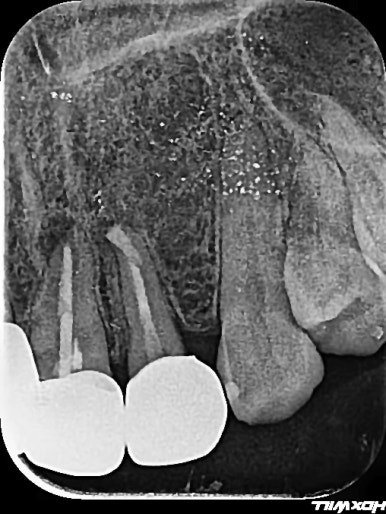
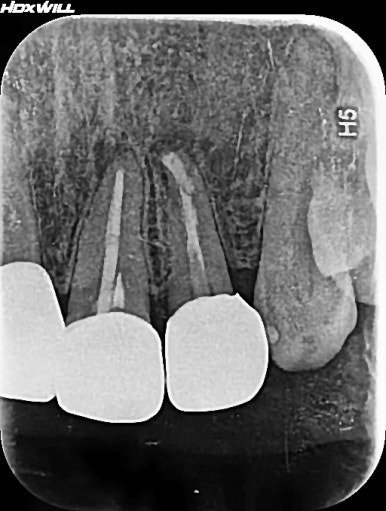
Right after treatment / X-ray comparison after 9 months
We checked again after 9 months.
The left is when treatment was completed, and the right is at the follow-up about 9 months later.
Even after 9 months, we checked the replanted tooth and the area around the root again.
“On the X-ray after 9 months, we checked the root of the replanted tooth and the surrounding bone,
and continued follow-up together with the clinical symptoms.”
Long-term follow-up is important after tooth replantation.
After intentional replantation, various changes such as root resorption, ankylosis and lesions around the root
need to be observed over a long period.
Therefore, rather than judging the long-term prognosis from photos right after treatment alone,
it is important to check changes in the root and surrounding tissue
through regular clinical examinations and X-rays.
This patient's course was as follows:
front tooth fracture → checking the previous root canal treatment and root-tip condition → evaluating the possibility of preserving the natural tooth
→ intentional replantation → MTA root-end treatment → 180-degree rotated replantation → checking healing progress
→ core and crown restoration → 9-month follow-up
in that order.
Can a broken front tooth always be saved?
Not necessarily.
Even though preserving the natural tooth is important,
forcibly saving a tooth that is hard to maintain is not always good treatment.
If the root is fractured or the remaining tooth structure is difficult to restore,
or if there is severe damage to the periodontal tissue, extraction may be more appropriate.
Conversely, rather than thinking only of an implant from the start just because the tooth is badly broken,
you can first evaluate the fracture location, the root condition, the previous root canal treatment, the periodontal tissue and the possibility of restoration
to see whether there is a way to preserve the natural tooth.
This case also does not show a treatment that can be applied to every broken front tooth;
it is the treatment process of one patient in whom, after evaluating various conditions, natural tooth preservation was attempted with intentional replantation
and the tooth was then restored with a crown.
*The treatment process and before-and-after photos of this case are published with the patient's consent.
Treatment methods and results vary from person to person. Intentional replantation is not a treatment that can be applied to every tooth, and depending on the shape of the root, whether it is fractured, the periodontal tissue, the remaining tooth structure and the possibility of restoration, it may be difficult to perform or extraction may be necessary. Even after treatment, various problems such as root resorption, ankylosis, inflammation and increased mobility may occur, so long-term follow-up is necessary.
#BusanToothReplantation #SeomyeonToothReplantation #ToothReplantation #IntentionalReplantation #BusanFrontToothTreatment #SeomyeonFrontToothTreatment #BrokenFrontTooth #FrontToothFracture #ToothFracture #NaturalToothPreservation #SavingNaturalTeeth #BusanFrontToothCrown #SeomyeonFrontToothCrown #FrontToothCrown #MTA #RootEndTreatment #SeomyeonDentist #SmileDigitalDental
Related cases:
Anterior Zirconia Crowns in Seomyeon, Busan: Improving the Shape of the Front Teeth
Seomyeon, Busan Front Tooth Crown: Re-Treating a Root-Only Tooth While Preserving It
Front Tooth Crown Retreatment in Busan Seomyeon: A Case With Root Canal Retreatment and Non-Vital Whitening
Related information: Same-day crown guide · General dental information is also available on the Korean Dental Association.