Hello.
From the heart of Seomyeon,
drawing tomorrow's smile,
This is Smile Digital Dental Clinic :)
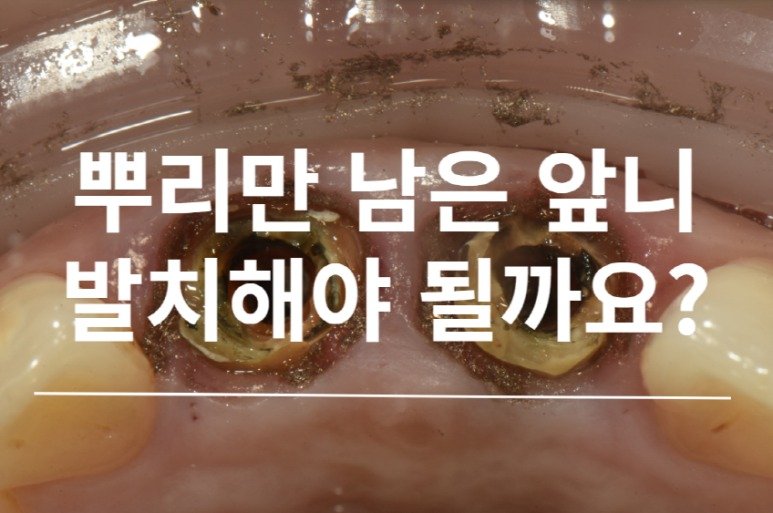
When an old front-tooth crown is removed and almost no natural tooth remains above the gum,
does the tooth always have to be extracted?
When a tooth is badly damaged and only the root remains, extraction may sometimes be necessary.
However, depending on the evaluation of the length and shape of the root, the extent of decay or fracture, the condition of the periodontal tissue and alveolar bone,
and whether the remaining tooth can be restored again,
there are also cases in which preserving the natural tooth
and treating it again with a crown can be considered.
Today I will introduce a case in which an old front-tooth restoration was removed and only the root remained,
and the remaining natural tooth was used to treat it again with a zirconia crown,
in a female patient in her 60s.
Table of contents
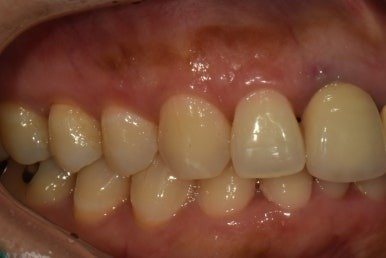
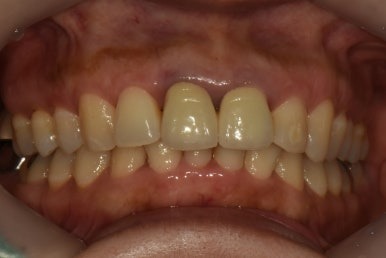
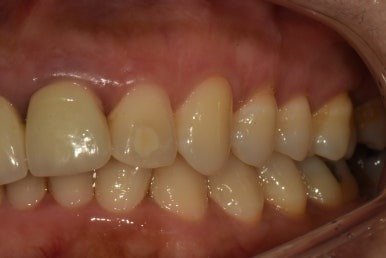
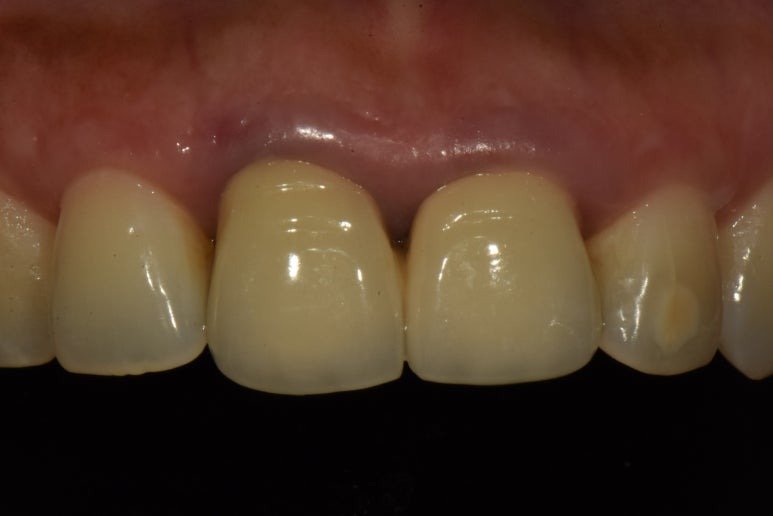
Front view before treatment
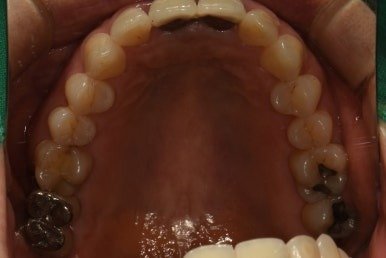
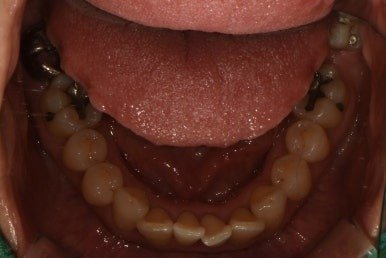
I want to replace my old front-tooth crowns.
The patient is a woman in her 60s.
She came in to have the front-tooth crowns she had received long ago replaced.
Her front teeth had PFM crowns, and the two crowns
were joined to each other.
From the front, the gum lines of the left and right front teeth differed, the border between the teeth and gums looked dark, and swelling of the surrounding gums was also observed.
Dark areas around a PFM crown do not mean that the gums have turned black
simply because of the metal.
The metal structure of the restoration, the position of its margin, gum recession, the color of the underlying tooth and core, and the surrounding tissue
can all play a role,
so we decided to remove the existing restoration and check the condition.
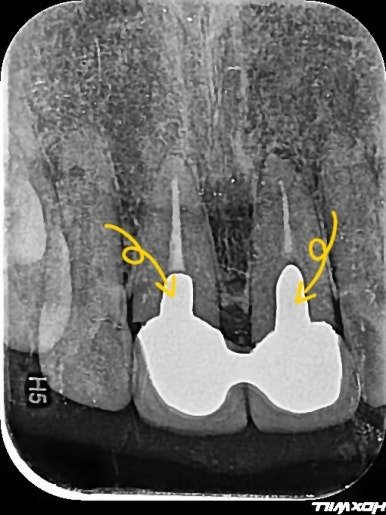
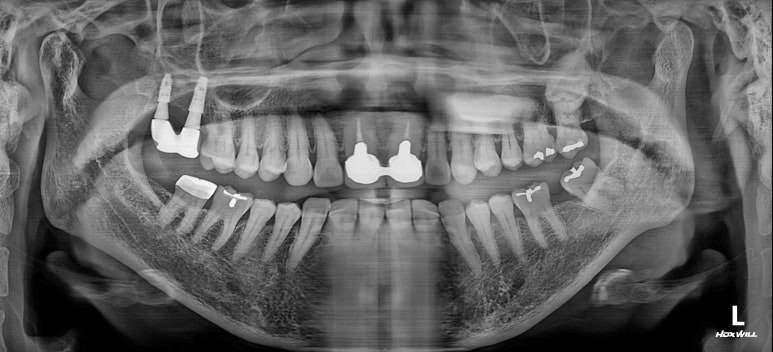
A large metal post was found on the X-ray.
This front tooth had previously received root canal treatment, and
a relatively large metal post was placed inside the root.
If the existing crown were removed, we needed to check how much natural tooth
actually remained.
In a tooth with an old post in particular, care must be taken during post removal
so that the root is not damaged, so
we made the treatment plan while checking the X-ray and the current condition of the tooth.
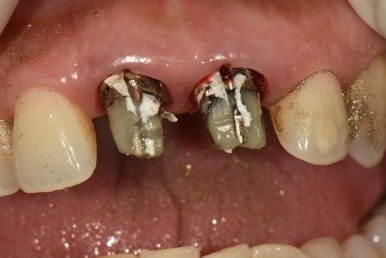
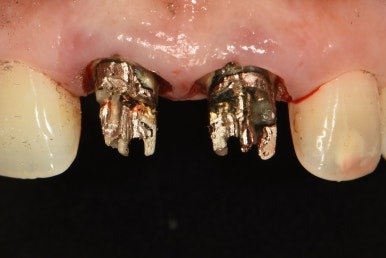
Right after crown removal
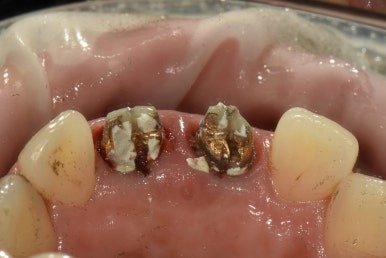
The old crowns were removed.
After removing the old crowns, little natural tooth remained in the crown portion,
and the metal posts and cores accounted for a large part of it.
We also judged that the dark area at the gum border was being affected by the color of the metal posts and
cores inside.
The next step was to remove the existing metal posts and then check the condition of
the natural tooth that actually remained.
After metal post removal
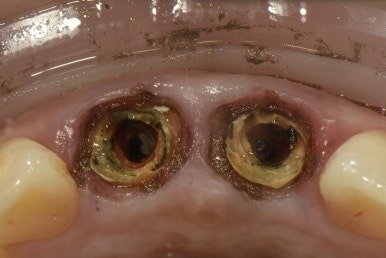
Only the roots remained after the metal posts were removed.
We removed the existing metal posts while taking care not to damage the roots.
After removing the posts, we found that very little natural tooth remained above the gum,
and most of the tooth structure remained on the root side.
When a tooth is this badly damaged,
whether to extract it and whether it can be preserved must be reassessed.
We cannot conclude that a tooth can always be saved just because the root remains, or conversely that
it must always be extracted just because only the root remains.
For this patient, after evaluating the remaining root, the surrounding tissue, and the possibility of restoration,
we decided to proceed with treatment in a way that preserves the natural tooth.
After fiber post + core
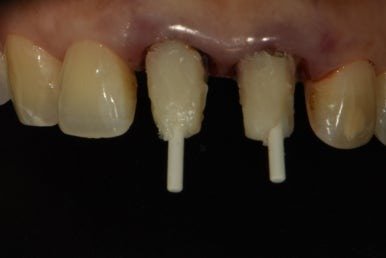
The remaining decay was removed and the posts and cores were remade.
After removing the decayed areas of the remaining tooth, we used fiber posts and resin cores
to retain the cores for the final crowns.
A fiber post is a tooth-colored post made of fiber-reinforced material, and it is one of the materials that can be chosen, especially for front teeth,
where esthetics must be considered.
However, using a post does not necessarily make a tooth stronger
or prevent root fracture.
The long-term prognosis of a tooth is affected by many factors, such as the remaining natural tooth structure and root condition,
the shape and position of the post, the final crown, and the bite.
There was not enough natural tooth structure for the crowns.
In the photo taken after the posts and cores were made, most of the part visible above the gum
was core, and the actual natural tooth structure was not sufficiently exposed.
When restoring a tooth with a crown, it is important to secure
sound natural tooth structure that the final restoration can wrap around, that is, to consider the ferrule.
The tooth structure needed depends on the condition of the tooth and root, the final restoration, the bite,
and other conditions considered together.
To secure these restoration conditions, for this patient
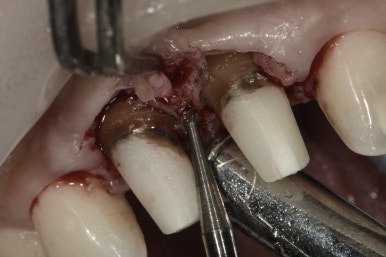
we decided to perform crown lengthening as well.
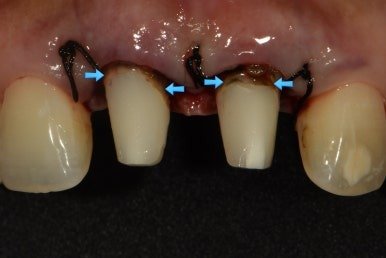
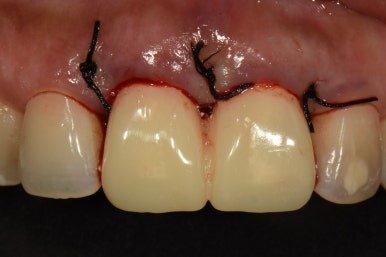
Crown lengthening secured the needed tooth length.
Through crown lengthening, part of the tooth that had been located below the gum was exposed
to secure the restoration conditions for the final crowns.
In addition, because the surrounding gums showed swelling and inflammation at the first visit,
we also carried out the necessary gum treatment.
A temporary tooth was used while the gums healed.
After crown lengthening, we did not make the final crowns right away; we used a temporary tooth
and observed changes in the surrounding gums.
The initial temporary tooth focused less on completing the final shape of the front tooth and more on protecting the treated tooth and maintaining its form while the surrounding tissue healed.
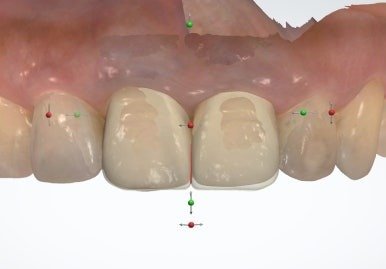
After the gums had begun to heal, we readjusted
the temporary tooth to check the shape of the final crown.
We checked the length and width of the front teeth, their left-right shape, the gum line, and so on,
and reviewed what should be reflected in the final restoration.
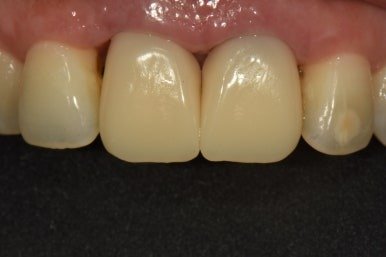
The joined crowns were replaced with separate crowns.
The existing front teeth had two crowns joined to each other.
This time, after evaluating the condition of each remaining tooth and the restorative conditions,
we made a separate crown for each of the two front teeth.
The final zirconia crowns were placed.
After checking the shape and the condition of the surrounding gums with the temporary tooth,
made the final zirconia crowns.
For the final restoration, we considered the color and shape of the neighboring teeth,
and also checked the length and width of the two front teeth and their relationship with the gum line.
Before treatment, the old joined PFM crowns, a dark color at the gum border,
and swelling of the surrounding gums were observed.
After removing the existing restoration, we checked the metal posts and the condition of the remaining tooth,
and re-treated the tooth with crown lengthening, a new core, and
zirconia crowns while preserving the natural tooth.
Right after the final crowns, a space between the teeth was visible.
In the photo taken right after the final crowns were placed, a space on the gum side between the front teeth was observed.
Before treatment, the surrounding gums were swollen, and through gum treatment and crown lengthening,
the shape of the soft tissue changed.
In such cases, rather than simply making the crown larger to hide the space,
the tooth shape, contact relationships, the condition of the gums and alveolar bone, oral hygiene, and so on should be considered together,
and the final shape of the restoration should be decided accordingly.
For this patient, we decided to observe the current condition and follow its progress.
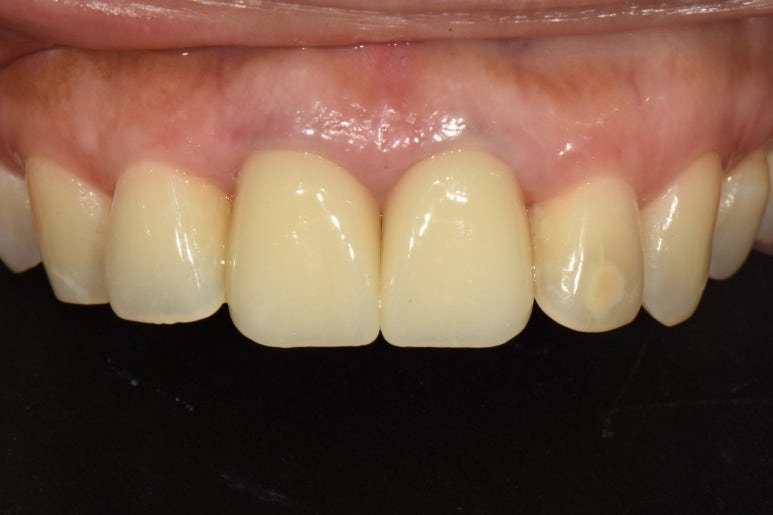
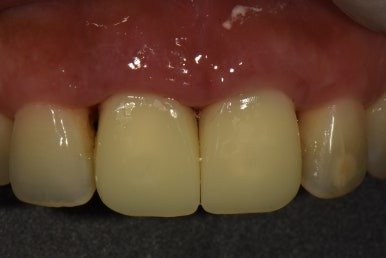
At a regular check-up, we checked the change in the gums between the front teeth.
This is a photo taken again at a later regular check-up.
Compared with right after treatment, you can see that the space that was visible between the front teeth has decreased
and the shape of the gum between the teeth has changed.
Compared with right after treatment, at the check-up the space between the teeth had decreased and the shape of the surrounding soft tissue had changed.
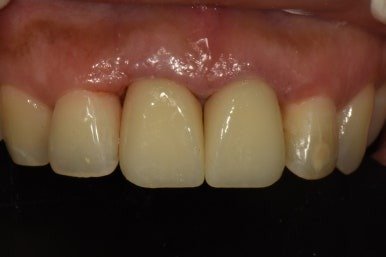
Can every tooth with only the root remaining be saved?
Not necessarily.
Whether a tooth with only the root remaining can be preserved depends on an overall evaluation of the length and shape of the root, whether it is fractured,
the extent of decay, the condition of the periodontal tissue and alveolar bone, the amount of sound tooth structure remaining, and whether
the tooth can finally be restored with a crown.
Depending on the case, crown lengthening or orthodontic extrusion may be considered, but if the condition of the root or the
periodontal tissue is poor, extraction may be more appropriate.
This patient's course was as follows:
removal of the old PFM crowns → removal of the existing metal posts
→ evaluation of the remaining root and the possibility of restoration → removal of decay → fiber post and core
→ crown lengthening and gum treatment → healing and shape check with a temporary tooth
→ separate zirconia crowns → regular check-ups
We treated her in this order.
Therefore, rather than generalizing that a tooth with only the root remaining can always be saved, the key point of this case is that before extracting a tooth, it is important to evaluate whether the remaining root can actually be restored.
The photos of the treatment process and before and after treatment in this case are posted with the patient's consent.
Treatment methods and results vary from person to person. Whether a tooth with only the root remaining can be preserved depends on the remaining tooth structure, the length and shape of the root, whether it is fractured, the extent of decay, and the condition of the periodontal tissue and alveolar bone, and extraction may be necessary in some cases. After crown lengthening, pain, bleeding, swelling, and gum recession may occur, and even after crown treatment, fracture, loss of the crown, secondary caries, and periodontal problems may occur, so regular check-ups and care are necessary.
#BusanFrontToothCrown #SeomyeonFrontToothCrown #FrontToothCrown #FrontToothCrownRetreatment #RootOnlyTooth #BusanRootOnlyTooth #NaturalToothPreservation #SavingNaturalTeeth #BusanFrontToothTreatment #SeomyeonFrontToothTreatment #OldFrontToothCrown #PFMCrown #MetalPost #FiberPost #CrownLengthening #ZirconiaCrown #SeomyeonDentist #SmileDigitalDentalClinic
What should I check when considering front tooth crown retreatment?
Over years of use, a front tooth crown is not just a momentary issue; the inside of the tooth and the gum condition can change together. When redoing a front tooth crown, you should first check the remaining tooth structure, the root and the gum condition, not just replace the crown. The method and duration of front tooth crown retreatment differ from case to case and are planned after an examination.
Related cases:
Front Tooth Crown Retreatment in Busan Seomyeon: A Case With Root Canal Retreatment and Non-Vital Whitening
Front Tooth Crown in Seomyeon, Busan: Non-Vital Tooth Whitening and Gum Surgery Together
Front Tooth Crown in Busan Seomyeon: Retreating an Old PFM Crown with a Zirconia Crown
Related information: Same-day crown guide · General dental information is also available on the Korean Dental Association.