
Hello.
This is Smile Digital Dental Clinic 🙂
Today we would like to introduce a front tooth crown re-treatment case from Seomyeon, Busan.
If an old front tooth crown is removed and not much natural tooth remains,
does the tooth always have to be extracted and replaced with an implant?
A small amount of remaining tooth does not mean extraction is necessary in every case.
We check the condition of the tooth root and surrounding tissue, the remaining tooth structure,
and whether conditions are suitable to hold a restoration,
and then review whether the natural tooth can be preserved and a crown placed again.
In today's case, after the existing front tooth restorations were removed, the amount of remaining tooth was small,
but crown lengthening, root canal treatment, and a Post & Resin core were used to reinforce the tooth,
and new front tooth crowns were made. This is the case of a patient in her 50s.
The patient came to us after learning about the philosophy and community activities of Smile Digital Dental Clinic.
To give neighbors who have difficulty receiving dental care an opportunity for treatment,
she visited us after learning of our agreements with the Busan Multicultural Family Support Center and Busanjin-gu Office.
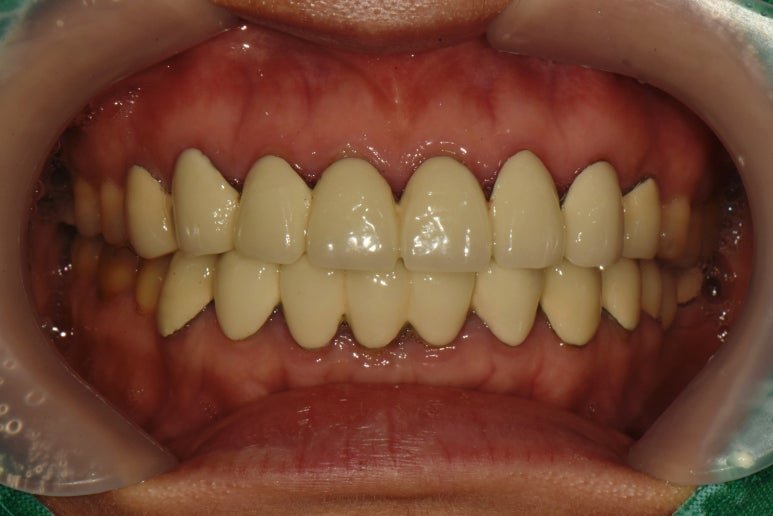
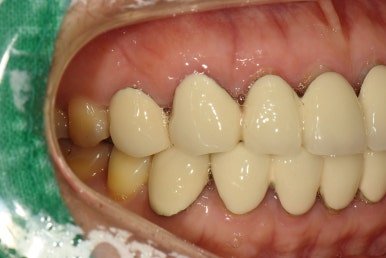
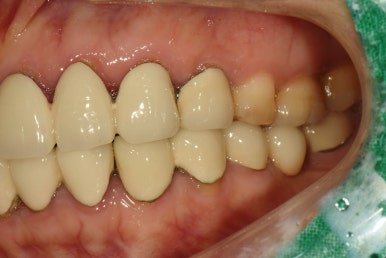
I want to have my old front tooth restorations treated again
A patient in her 50s.
She was concerned about the shape of her existing front tooth restorations and the dark color around the gums,
and visited us to have her front teeth restored again.
Before treatment, several upper and lower front teeth had been treated with connected restorations.
A dark tone was observed at the border between some restorations and the gums,
and the hygiene around the existing restorations also needed to be checked.
The existing restorations were PFM (Porcelain Fused to Metal) crowns,
in which a tooth-colored material is applied over a metal structure.
Long-term use of a PFM crown does not necessarily cause the gums to turn dark.
Depending on several factors, such as the margin of the restoration, the condition of the gums, gingival recession,
and the color of the metal structure or of the tooth itself,
the area around the gums may look dark.
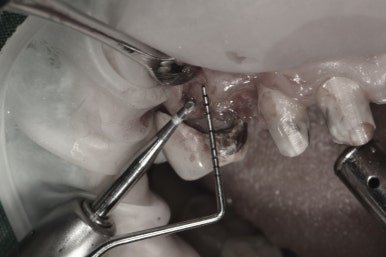
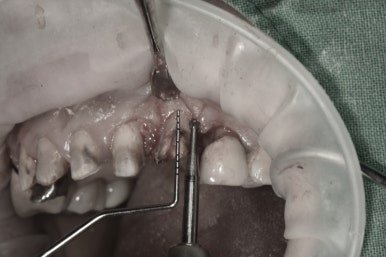
We removed the existing restorations and checked the remaining teeth
After removing the front tooth crowns, we checked the condition of the remaining natural teeth.
In some teeth, the tooth structure needed to hold a crown stably
was not sufficient.
In such cases, rather than making a new crown right away,
it is necessary to first determine whether the remaining tooth can be preserved
and restored again.
After checking the tooth root, surrounding tissue, and the amount of remaining tooth,
for this patient, we proceeded with crown lengthening and the necessary root canal treatment rather than extracting right away,
and made a treatment plan aimed at preserving the natural teeth.
Why was crown lengthening performed?
Crown lengthening is one of the treatments that exposes tooth structure located below the gum line as needed,
creating conditions for later restoration or prosthetic treatment.
Because this patient had little remaining tooth structure,
it was performed to secure tooth structure that could support a new crown.
Not every severely damaged tooth can be preserved with crown lengthening.
The length and shape of the remaining root, the condition of the alveolar bone and periodontal tissue,
the expected crown-to-root relationship after restoration, and the neighboring teeth must be considered together.
The patient also underwent the necessary root canal treatment while preparing for the later prosthetic treatment.
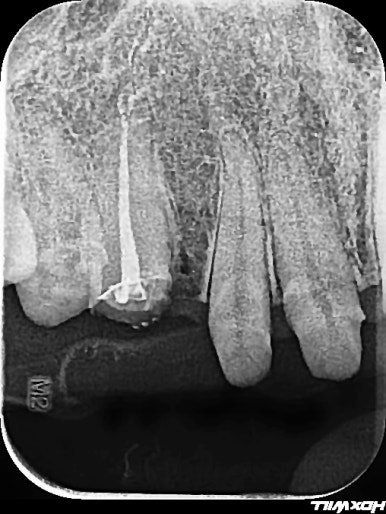
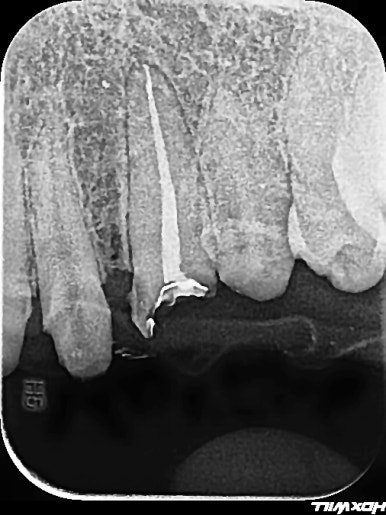
After crown lengthening, we checked the exposed tooth structure,
and reinforced the insufficient tooth structure with a Post & Resin core.
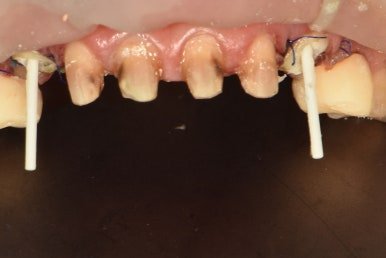
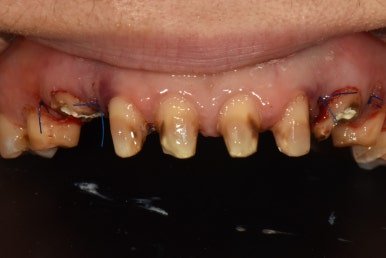
The insufficient tooth structure was reinforced with a Post & Resin core
After crown lengthening and the necessary root canal treatment, we checked the condition of the remaining tooth
and reinforced the insufficient tooth structure with a Post & Resin core.
A post and core can be used in a root canal-treated tooth with insufficient remaining tooth structure
to create the form needed to make the final crown.
Using a post does not make the tooth itself stronger than it originally was.
Whether to use one is decided by considering several factors, such as the amount and position of the remaining tooth, the condition of the root,
and the shape and bite of the final restoration.
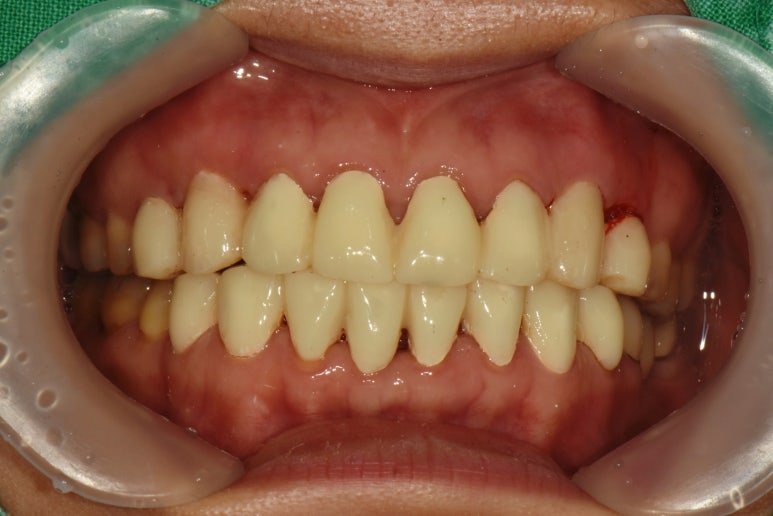
We checked the shape while adjusting the temporary teeth several times
After root canal treatment and tooth reinforcement, temporary teeth were placed.
Because several front teeth were re-treated together for this patient,
the temporary teeth stage was especially important.
Temporary teeth protect the teeth until the final crowns are made, and can also be used to
check the length, width, and alignment of the front teeth, and the relationship between the gums and the restorations —
before the final restorations are made.
In this case, the temporary teeth were made using digital scan data,
and during the treatment period, the shape was modified and refined 2 to 3 times while
checking the shape of the final restorations.
After crown lengthening, we also observed changes in the surrounding gums.
As the gums and surrounding tissue changed, we adjusted the shape of the temporary teeth,
and also checked the length and shape of the front teeth that the patient wanted.
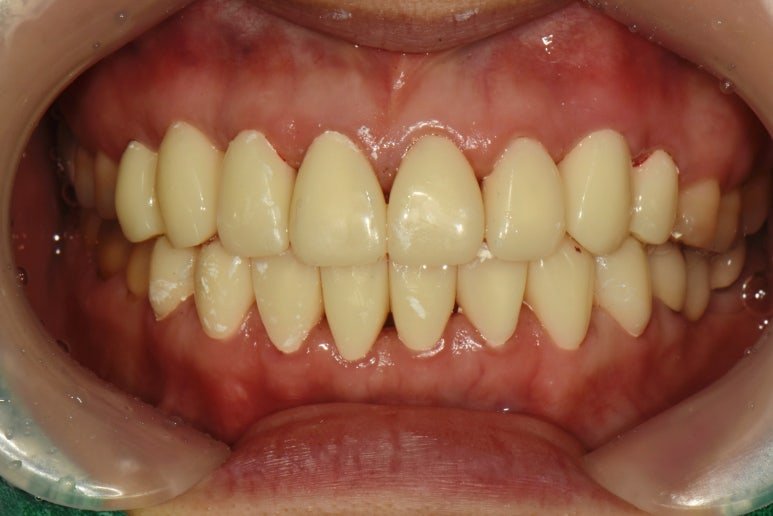
We checked the final shape based on the last temporary teeth
These are the last temporary teeth used before making the final restorations.
When treating several front teeth together, rather than making the final crowns right away,
the length, width, alignment, and overall shape of the teeth can be checked through temporary teeth
together with the patient.
After the patient checked the shape of the temporary teeth,
we proceeded to make the final restorations based on it.
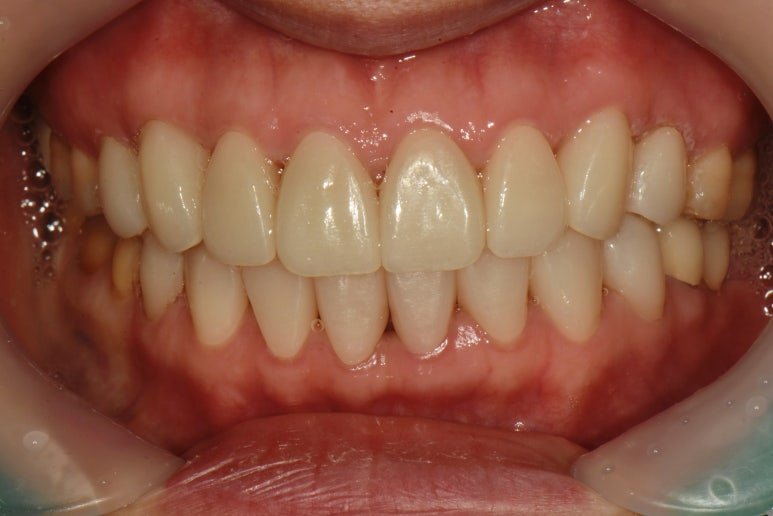
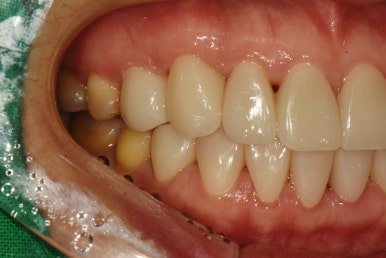
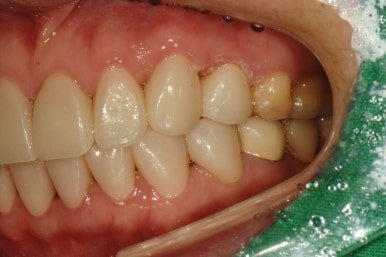
Final restorations were placed after front tooth crown re-treatment
This is how it looked after the final front tooth crowns were placed.
The final restorations were made with reference to the shape confirmed at the temporary teeth stage.
When treating several front teeth together, we look not only at individual teeth,
but also at the relationship with adjacent teeth, the length and width of the teeth, the gum line, the relationship with the lips,
and the bite together.
After checking the fit, contact relationships, and bite of the restorations in the mouth, they were placed as final restorations.
You can see the process in which the existing connected restorations were removed, the condition of the remaining natural teeth was checked,
and new front tooth restorations were made through several stages of treatment.
This treatment was not simply a case of replacing an old front tooth crown with a new one.
Removal of existing restorations → Evaluation of remaining teeth → Crown lengthening
→ Necessary root canal treatment → Post & Resin core
→ Checking shape and gum condition with temporary teeth → Final front tooth crowns
were carried out in this order.
If little tooth remains, does it always have to be extracted?
Not necessarily.
On the other hand, not every tooth can be preserved either.
Preservation may be difficult if very little tooth structure remains, if there is a fracture in the root,
or if the condition of the periodontal tissue or alveolar bone is poor.
It is important to evaluate whether the tooth, if preserved,
has conditions to function in the long term.
For this patient, after reviewing whether the natural teeth could be preserved and restored again,
the final front tooth crowns were made after crown lengthening, the necessary root canal treatment,
and tooth reinforcement.
If you need to replace an old front tooth crown,
or have been told that little tooth remains after the existing restoration is removed,
before deciding on extraction, it is important to check the current tooth root, periodontal tissue,
and remaining tooth structure to evaluate whether conservative treatment is possible.
Points to check when considering front tooth crown re-treatment
Front tooth crown re-treatment does not simply mean replacing an existing restoration with a new one.
When planning front tooth crown re-treatment, we first check the amount of tooth that remains after the existing restoration is removed, and the condition of the root and periodontal tissue.
Whether front tooth crown re-treatment is needed, and whether the remaining tooth can be preserved, is determined through an oral examination and X-ray examination.
Even for the same front tooth crown re-treatment, the treatment method and duration may differ depending on the condition of the teeth.
Even after front tooth crown re-treatment, hygiene care around the restoration and regular checkups are needed.
How to care for the teeth after front tooth crown re-treatment may differ depending on the condition of the gums and teeth.
If you have questions before front tooth crown re-treatment, please ask during your consultation.
General information on tooth preservation and prosthetic treatment is also available from Korean Dental Association.
If you are considering front tooth crown re-treatment, please request a consultation on the Reservation / Inquiry page.
Related cases:
Front tooth crown: re-treating a tooth with only the root remaining by preserving it
Front tooth crown re-treatment: root canal re-treatment and non-vital tooth whitening
Re-treating an old PFM crown with zirconia
Same-day crown guide
Related pages: Digital Esthetic Dentistry · Reservation / Inquiry
The before-and-after photos in this case were published with the patient's consent.
Treatment methods and results vary from person to person.
Depending on the condition of the remaining tooth structure, roots, alveolar bone, and periodontal tissue,
preserving the natural tooth may be difficult,
even after crown lengthening, root canal treatment, and post and crown treatment,
additional treatment or extraction may be needed.
The specific treatment method is decided after an examination.
#BusanFrontToothCrown #SeomyeonFrontToothCrown #FrontToothCrownRetreatment #FrontToothRerestoration #NaturalToothPreservation #CrownLengthening #PostAndCore #SmileDigitalDental